By Ed Staskus
Emma started baking when she was six years old, although it wasn’t exactly real baking. She baked small cakes in an Easy-Bake oven, which was a working toy oven. At first, when it was introduced in 1963, the heat source was two light bulbs. Hers had been the newer Ultimate Oven model, which used a real heating element. The baking was easy. There were Easy-Bake cake mixes and small round pans. She poured the cake mix into a pan, added water, blended it, and then pushed the pan through a slot into the oven. After the baking was done she pushed the pan out through a slot at the back end of the oven.
Now that she was thirteen years old she baked for real. Her mother was a good cook, but her father was a better baker. He was an electrical engineer and knew all about energy getting the job done. “Baking is a science,” he said when he began teaching her everything he knew. “It’s all about precise measurements and proper techniques. It’s about the chemical reactions that happen when ingredients are combined and exposed to heat, like the leavening agents in baking powder that create bubbles in batter. Do you follow me?”
“I guess so.”
“All right, let’s start at the beginning by cracking eggs.”
She wasn’t a beginner anymore. She knew the four pillars of baking, which were flour, eggs, sugar, and fat. Flour and eggs were structure builders while sugar and fat were tenderizers. She wasn’t good enough to make yeasted breads and laminated pastries, yet, but she was a hotshot with cookies, brownies, and cakes.
Her brother Oliver was going to be eleven years old in exactly one day. She was planning on baking a cake for him. It was going to be a black cake made from a recipe by Emily Dickinson. Black cake is a kind of Caribbean Christmas cake, a close relative of British fruit cake.
Emma was a big fan of reading. She had started reading Emily Dickinson’s poems when her aunt gave her “Poetry for Kids: Emily Dickinson” two years ago for her birthday. Since then she had read “A Voice of Her Own: Becoming Emily Dickinson,” which was a biography, and read every one of her poems, all one thousand eight hundred of them, in one library book after another. Only ten of the poems were ever published during Emily Dickinson’s lifetime.
“A bird came down the walk, he did not know I saw, he bit an angleworm in halves and ate the fellow, raw, and then he drank a dew from a convenient grass, and then hopped sideways to the wall to let a beetle pass.”
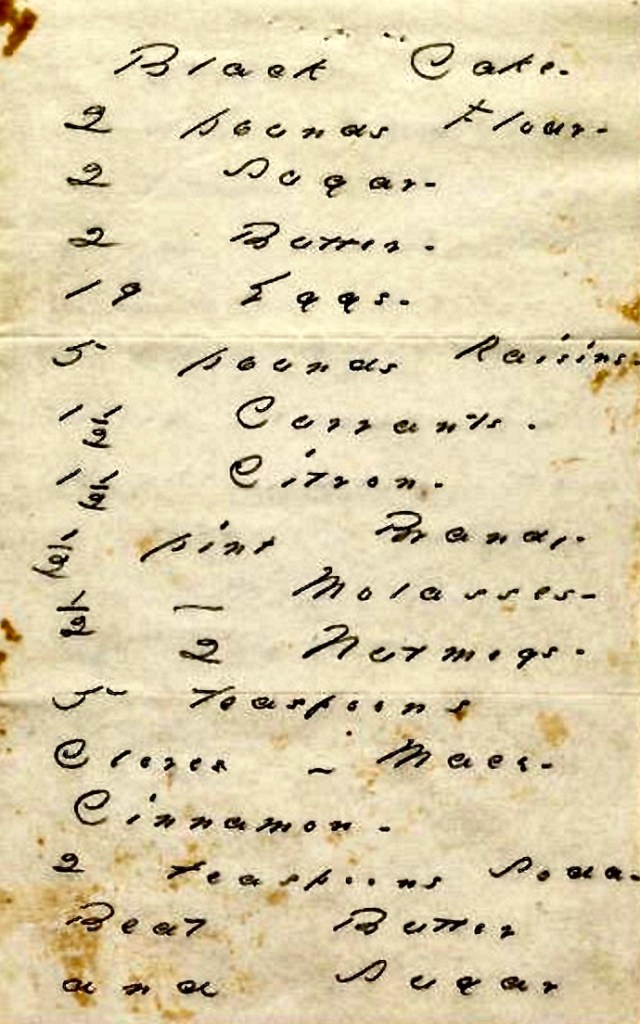
What most people didn’t know about Emily Dickinson was that she was a very good baker. She was better known for her desserts than her poems. She was especially skillful with bread. She won second prize at the 1856 Amherst Cattle Show for her rye and Indian round bread. Emma knew all about her baking prowess because she had discovered “The Emily Dickinson Cookbook” which was full of recipes for gingerbread and chocolate caramels. It was where she found the recipe for black cake.
There was a copy of the hand-written recipe, written in Emily Dickinson’s hand, in the book. She had a funny way of forming her letters. It took some getting used to. Emma had the book propped open on the kitchen counter.
She had her work cut out for her. The recipe called for two pounds of flour, two pounds of butter, five pounds of raisins, and nineteen eggs, among other ingredients. It made a twenty pound cake. She didn’t have a cake pan that could contain any such thing. She wasn’t sure if such a thing would even fit in their oven.
She got to work, cutting the recipe down to size, leaving the brandy it called for out of the batter, and by the end of the afternoon the cake was in the oven, baking away. That is when she heard a voice speaking from the oven.
“You do know that’s a Christmas cake, don’t you?” the voice, which sounded like Foghorn Leghorn, said.
“I know, but it’s February, which is close enough,” Emma said.
“Do you know the roots of that cake go back to slavery?”
“I didn’t know that.”
“And Emily Dickinson couldn’t have ever baked it if it wasn’t for the slaves in America.”
“What do you mean? Her family never had slaves. They didn’t like slavery. Her father was a lawyer and he stood up for three black men who rescued a girl who was about to be sold into slavery. Their gardener, Jeremiah, was black. He got paid for his work. He wasn’t a slave.”
“Emily Dickinson hated black people,” Foghorn Leghorn said.
“How do you know that?”
“Everybody knows that.”
Emma didn’t know that. If everybody knew it, how come she didn’t know it? None of the poems had anything about black people or slavery in them. She should know, since she had read all of them.
“Have you read her poems?” she asked the voice.
No, but it’s like the Bible. You don’t have to read the Good Book to know what its message is.”
“That doesn’t sound right.”
“You’re too young to understand.”
Emma didn’t like being told she was too young to understand.
“I understand full well that you can’t know what’s in a book unless you read it. Talking about Emily Dickinson without reading what she wrote would be like giving a fish a bath.”
“You do know why the cake is black, don’t you, little girl?”
Emma did not like being called a little girl, either. “No, I don’t know, but I don’t see why it matters.” She was getting tired of Foghorn Leghorn.
“It’s called black cake because the color comes from molasses and spices, which were sourced from slave plantations in the Caribbean.”
“I didn’t use molasses, smarty pants, I used sugar.”
“Burnt sugar?”
“Yes, otherwise the cake wouldn’t be black.”
“Well, I hope you know what you’re doing.”
“I’m the one baking it and whether it comes our black, or not, I say it’s a black cake,” Emma said, digging in her heels. Why was Foghorn Leghorn in her oven? She looked inside of it but didn’t see anything except for the cake. Where was he? Did he get burned up? She didn’t see any ashes.
“Emily Dickinson’s poems should be burned on the bonfire of bad history. She was an elitist.”
“What does elitist mean?”
“Elitists think wealth, intellect, and social status make them superior and those who have those qualities should have more power and influence.”
“She lived on a farm, not in a mansion,” Emma said. “They had pigs, cows, horses, a fruit orchard, and a hay meadow. They grew most of their own food. She had a big garden and was always working in it. Everybody said she had a green thumb. She baked twenty pound cakes. She sometimes complained about all the work she had to do. Lots of her poems are about fields and farm life.”
“To make a prairie it takes a clover and one bee. One clover, and a bee, and reverie. The reverie alone will do, If bees are few.”
“If she wasn’t an elitist, why was she always wearing white?” Foghorn Leghorn crowed.
“Who says she always wore white?”
“Everybody says so.”
“Everybody is wrong, just like you. There’s only one photograph of her and she’s wearing a dark dress. She wore clothes made from unbleached linen and hemp and wool. Most of her clothes were brown-hued. Most of the time she probably wore simple linen skirts as an underlayer topped by a dark woolen overskirt.”
“How do you know that?”
“I read it in a book.”
“I don’t like reading, too much work. I like watching TV. I like movies that are based on comic books and cell phone apps. I like the internet. There are lots of pictures.”
“Why are you picking on Emily Dickinson?”
“She thinks she’s all that with her fancy poems.”
“I’m sorry Mr. Leghorn, but you’ve got to go. My cake is almost done and I’m done listening to you.”
The next morning was a cold February morning, but sunny.
“Not knowing when the dawn will come I open every door,” is what Emily Dickinson said about mornings.
Oliver had black cake for breakfast on his birthday.
“This cake is boss, sis, thanks so much,” he said.
“My pleasure,” Emma said.
Ed Staskus posts monthly on 147 Stanley Street http://www.147stanleystreet.com, Made in Cleveland http://www.clevelandohiodaybook.com, Down East http://www.redroadpei.com, and Lithuanian Journal http://www.lithuanianjournal.com. To get the site’s monthly feature in your in-box click on “Follow.”
Made in Cleveland” by Ed Staskus
Coming of age in the Midwest in the 1960s and 1970s.
“A collection of street level short stories blended with the historical, set in Cleveland, Ohio. The storytelling is plugged in.” Sam Winchell, Beyond Books
Available on Amazon:
A Crying of Lot 49 Production




 Monster Hunters of Lake County