Crashing Into Shadows

By Ed Staskus

   Emma was dozing in the back seat, her head slumped on her brother’s shoulder, the night they discovered the truth about Shadow Man. Oliver had heard of him, but since they were leaving Prince Edward Island in a few days, going home to Ohio, he had almost given up hope of running into him. Even though he was only ten years old, he was as a rule prepared for the worst when it came to monster hunting, but always hoped for the best.

   Oliver was an accomplished monster hunter. His older sister Emma was his right hand man. Their parents were in the front seats, their father driving and their mother scrolling through her cell phone. It was nearing eleven o’clock. They had been in Charlottetown, at the Irish Hall, where they had seen the band Fiddler’s Sons. They were returning to the Coastline Cottages in North Rustico, where the family had been staying for nearly two weeks.

   They took a wrong turn leaving Charlottetown and ended up on Rt. 15 instead of Rt. 223. “No matter,” their father said. “We’ll drive up to Brackley Beach and from there all we have to do is turn left to North Rustico.” Getting back to their cottage from there meant going through Rustico, Rusticoville, South Rustico, and Anglo Rustico, which were along the way.

   North Rustico was founded in the late 18th century. Nobody is sure exactly when. It is on a natural harbor on the Gulf of St. Lawrence. There is a food market, a hardware store, a Lions Club, and about six hundred people live there. René Rassicot, a French pioneer, was one of the first settlers in North Rustico. All the rest of the nearby Rustico towns take their name from him.

   They were driving down a stretch of Rt. 6 near South Rustico when the road was engulfed by green fog. Suddenly, out of nowhere, there was somebody in front of their car. He was a tall man wearing an old-fashioned flat brim hat and a long black coat. Their father slammed on the brakes but it was too late. The car hit the man and sliced through him like he was nothing.

   “Stay here,” Oliver’s father said, coming to a stop and jumping out of their Jeep Cherokee. He was shaken. He scanned the ground with a flashlight. Nobody was lying dead on the road or in the bar ditch. Oliver twisted around and peered through the rear window.

   Emma woke up. “What’s going on?” she asked.

   “I think dad hit something,” Oliver said. He climbed out of the back seat. Emma followed him. Their mother kept her hand on her cell phone, ready to call 911.

   “He came out of nowhere,” their father said. “He was in the middle of the road but now he’s nowhere.”

   “I have nowhere else to go,” a voice said.

   Oliver, Emma, and their father looked in all directions, looking for the voice. A man walked out of the fog towards them. He was still wearing his old-fashioned flat brim hat. He was more silhouette than flesh and blood. He didn’t look hurt in any way. He was carrying a mace in his right hand. It was an aspergillum, a liturgical implement used to sprinkle holy water. 

   “It’s my double-edged sword, in case my sacred water doesn’t work on the fiend,” he said. “In that case I will send him back to Hell by smashing him with God’s instrument.”

   “We thought we hit you in the road. Are you all right?”

   “Yes, I am all right,” the man said. He had a French accent. His voice had a slight echo to it

   “Who are you?”

   “He’s the Shadow Man,” Oliver said. He knew his phantoms.

    “I am the shade of Rene Rassicot, after who these lands are named,”  the man said, fog rolling off his shoulders. “Some call me the Shadow Man. I do not terrorize the living. I watch over those on my lands, especially at night, when their dreams leave them exposed to danger.”

    “Are you immortal, or something?” Emma asked.

   “All creatures, except for man, are immortal because they are ignorant of death. Being a man, I am not immortal, although I was once threatened with immortality, which is more terrible than being threatened with death.”

   “Are you alive now?”

   “Yes and no, my young girl. My advanced age has resigned me to being Shadow Man. I miss my wife. I miss my family. I miss the smell of coffee and tobacco.”

   “What are you watching out for?” Oliver asked.

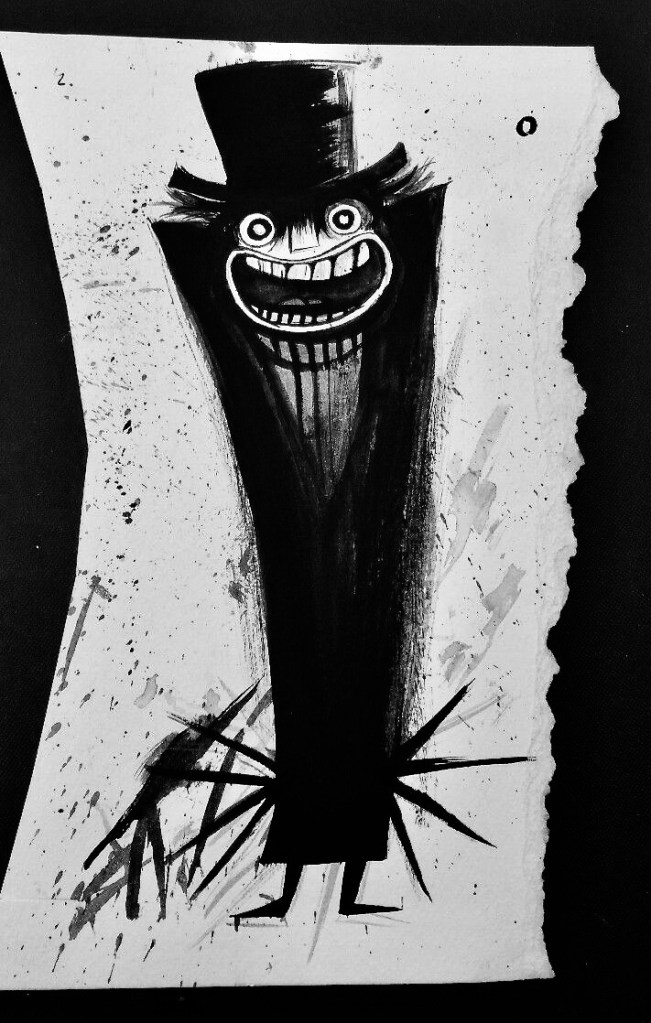
   “I am watching out for Mr. Babadook. He prowls these coastal lands from Brackley Beach to Stanley Bridge. He is furtive and cold-hearted. He strikes a pose in a beaver pelt top hat. He wears black mouth paint and his long spindly fingers are knife-like claws. He feeds on bowls of worms.”

   “I’ve never heard of Mr. Babadook,” Emma said.

   “He is the fiend who has oppressed me these past one hundred years,” Shadow Man said. “I have sometimes been confused with him since 1925, when Mr. Babadook was brought to this island in a children’s book.”

   “He came here in a book?” Oliver asked.

   “Yes, a pop-up book.” 

   The first pop-up book was “Little Red Riding Hood” published in 1855. It was called a scenic book. Seventy years later the Big Bad Wolf had become Mr. Babadook. He and the wolf shared the same kind of teeth and unholy appetites.

   “What does he do?” Oliver asked.

   “He knocks on your door, disappears, but leaves behind his red pop-up book meant for children’s night stands.”

   “What happens if children read the book?”

   “When they open the book they read, ‘You can make friends with a special one.’ By the time they get to the middle of the book they read, ‘You cannot get rid of me!’ After that they can’t help turning page after page. When they finish the pop-up book Mr. Babadook moves into their basement and gains control of the house and the family. In the end what happens is madness.”

   “That sounds terrible,” Emma said. “Why hasn’t anybody stopped him?”

   Their father wanted to say there isn’t any such thing as dream police, although he conceded there were dream monsters. Before he could say anything, however, Oliver piped up.

   “Dad, can Shadow Man come with us? He could sleep in Cottage No.1 since it’s empty. We could search for Mr. Babadook tomorrow. Maybe if we put our heads together we could put a stop to what he has been doing. We don’t have anything planned, do we?”

   His mother was all set to say they had plenty planned and Shadow Man should go back to where he came from, but before she could get a word out her husband said, “Get in the back. My son and you can go look for Mr. Babadook tomorrow, although you should know you won’t have much time since we are going home to Ohio in a few days.”

   “What about me?” Emma said, knowing full well she would be in on the hunt, no matter what.

   “We three will find him,” Shadow Man said.

   What he didn’t say was that Mr. Babadook might find them first. The top-hatted bogeyman was always on the prowl for children. Shadow Man looked at the two youngsters in the car and thought he must make a plan.

Next: Bye Bye Mr. Babadook

Ed Staskus posts monthly on 147 Stanley Street at http://www.147stanleystreet.com, Made in Cleveland http://www.clevelandohiodaybook.com, Down East http://www.redroadpei.com, and Lithuanian Journal http://www.lithuanianjournal.com. To get the site’s monthly feature in your in-box click on “Follow.”

“Ebb Tide” by Ed Staskus

“A thriller in the Maritimes, out of the past, a double cross, and a fight to the finish.” Sam Winchell, Beyond Books

Available at Amazonhttps://www.amazon.com/dp/B0CV9MRG55

Summer, 1989. A small town on Prince Edward Island. Mob money on the move gone missing. Muscle from Montreal. JT Markunas, an RCMP constable working the back roads, stands in the way.

A Crying of Lot 49 Publication

Swamp Thing

By Ed Staskus

   “There is no Bayfield,” Oliver’s father said as he, his wife, and two children stood next to a sign on the side of the road saying “Bayfield.” The four of them looked in all four directions. They looked at the sign again. It was a bright sunny day. There wasn’t a cross road and there were no buildings. There was no town. Oliver’s father looked at his son,  who was looking at a road map.

   “Are you sure this is where the Swamp Lady is supposed to be?”

   Oliver was the Monster Hunter of Lake County. The county was in Ohio, just east of Cleveland. The family was on Prince Edward island enjoying a two week vacation. Emma was Oliver’s sister. She was 12 years old, two years older than Oliver. She was his right-hand man when it came to monster hunting.

   “This is the place, dad,” Oliver said.

   Bayfield is on the east end of Prince Edward Island, just west of North Lake. It is named after Admiral Henry Bayfield, who surveyed the coast of the island for the British Admiralty between 1842 and 1845. He spent long days tramping through woodlands to get to coastlines.

   “What I’m trying to say, Ollie, is that when it comes to this place, there is no place here.”

   Oliver was looking for the Swamp Lady. She roamed the road between Bayfield and Glencorradale. There is a large marsh along that stretch of road, hundreds of acres of it, mostly covered over by woods. The first sighting of the Swamp Lady was by Little Johnny MacDonald. It happened long ago. Little Johnny had a farmhouse and a plot of land near Bayfield. He was going home after a kitchen party one night in his horse and buggy, One minute he was looking at the rear end of his horse and the next minute he had a feeling that somebody was close by. He looked over his shoulder and saw a queer woman beside him. 

   She was sitting silently and staring straight ahead. Little Johhny didn’t know what to say and so stayed the course, letting the horse find its way. When he looked again the woman was no longer beside him. He stopped his horse and jumped out of the buggy. The Swamp Lady was nowhere to be seen. 

   “Why is she called the Swamp Lady?” Emma asked.

   “Her clothes are always wet,” Oliver said. “Her eyes, lips, and hair are black. Her dress is in tatters. Her feet are bare and dark with mud. She carries a lantern, even though it’s always unlit. When she talks her voice sounds like bubbles. But mostly, she’s called that because she lives in a swamp.”

   “All right, smarty pants,” Emma said.

   When Josephine Miller was a girl living on Priest Pond northeast of Bayfield, one early spring day she and her family hitched up the horse and went to visit relations who lived on the edge of what she called “the big bog.” They were visiting because there had been  a death in the family. On the way they saw the Swamp Lady behind a tree on one side of the road and then behind another tree on the other side of the road. 

   “Don’t mind that,” her father said. The closer they got to their relation’s farm the farther it appeared they had to go. They seemed to be moving but were stuck in the same place. The big horse pulling their wagon was walking, but no matter how much the horse walked it didn’t seem to be getting anywhere. 

   The horse and wagon finally came to a standstill. Josephine’s mother reached into the basket beside her and pulled out one of the raisin pies in it. She hopped off her seat and put the pie on the side of the road. As soon as she was back in her seat the horse and wagon began to move for real. When they looked back the Swamp Lady had the pie in her hands and was walking back into the forest.

   Raisin pie was often served in those days to family and friends at a wake following a funeral.  It was commonplace to take a gift of food to pay your last respects. Most homes had dried raisins on hand. The pie was a favorite because the ingredients were always available and the pie kept well.  That meant it could be made weeks before whatever funeral needed a pie.

   Don MacGregor grew up in nearby East Baltic but lived in Bayfield. He married his wife Elaine in the late 1970’s. One summer night he decided to join his wife at a friend’s house in Rock Barra for a card game. The friend lived on the other side of the swamp. His wife had taken the car, so he started walking. The walk was going to be twenty-or-so minutes. Half way there he caught sight of a haggard woman standing on the road. She was wearing a white wet dress. She was the Swamp Lady. She watched him silently as he approached. He walked slowly past her, tipping his hat as he did. The woman’s face were blank as an owl’s eyes. As soon as he passed her he started running. He didn’t stop until he got to the front door of the house where the card game was going on.

   “What’s the matter with you?” his wife asked. “You’re pale as a ghost” 

   “I think I’ve just seen one,” he said.

   “It was probably the Swamp Lady,” his wife said, declaring the total value of her unmatched cards and saying “Knock.” They were playing Gin.

   “The who and what did I see?” he asked.

   “The Legend of the Northside,” one of the other card players said nonchalantly while handing Don a stiff drink.

   “Come on, Ollie, it’s getting dark,” Oliver’s father said. ”It’s time we get back to North Rustico.” They were staying at the Coastline Cottages on the seashore just off the town’s harbor. Everybody piled into their Jeep Cherokee and they drove away.

   The Swamp Lady watched them drive away. “I’ll have to talk to that wee boy if he ever comes back by himself” she said to herself before taking a bite of the slice of raisin pie she had in her hand. She only talked to those who believed in her existence. She never said a word to those who doubted her. She didn’t doubt that Oliver believed in her. 

   She would wait for the boy. She had all the time in the world. The swamp was here to stay. Neither it nor she were going anywhere.

Ed Staskus posts monthly on 147 Stanley Street at http://www.147stanleystreet.com, Made in Cleveland http://www.clevelandohiodaybook.com, Down East http://www.redroadpei.com, and Lithuanian Journal http://www.lithuanianjournal.com. To get the site’s monthly feature in your in-box click on “Follow.”

“Ebb Tide” by Ed Staskus

“A stem-winder in the Maritimes.” Sam Winchell, Beyond Fiction

Available at Amazon: https://www.amazon.com/dp/B0CVDP8B58

Summer, 1989. A small town on Prince Edward Island. Mob money on the move gone missing. Two hired guns from Montreal. One RCMP constable stands in the way.

A Crying of Lot 49 Publication

Beyond the Haunted Motel

By Ed Staskus

   The Adventure Zone in Cavendish on Prince Edward Island’s north coast is three attractions. One of them is the River of Adventure Mini Golf Course. The second one is the Hangar Laser Tag Arena. The last one is the Route 6 Haunted Motel. Neither Oliver nor Emma planned on playing golf until they were senior citizens. They couldn’t play laser tag because their parents didn’t want their children playing with guns, even if the gunplay was called laser tag. What Oliver and Emma were mainly interested in was the Haunted Motel.

   They had a professional interest in it. Oliver was the Monster Hunter of Lake County and Emma was his right- hand man They were from Ohio. They were on the island with their parents on a two-week vacation.

   They were standing in front of the Haunted Motel, sizing it up, when two children walked out of the Hangar Laser Tag Arena. One of them was a big boy wearing a pink sweatshirt. The other one was a black-haired girl wearing baggy Sinbad pants.

   “When we went one-on-one, I totally destroyed you,” Big Pink said.

   “Sure, but when we played that family, I dominated,” Baggy Pants said.

   “You were super good at sneaking around, getting behind them, and shooting, shooting, shooting,” Big Pink said. “You would just surprise run up and shoot them in the back the whole time.”

   “Sneak attacks are the best,” Baggy Pants said.

   A pack of  tweens came out of the Haunted Motel while Oliver and Emma were wondering whether to try it out.

   “That was twice as scary as the Haunted Mansion in Kensington,” one of them declared.

   “I know why they say ‘No Money Back’ if you leave early,” another one said.

   “Did you see that moon faced boy crying?” 

   “Yeah, he looked all freaked out.”

   “How about that mom who ran out? She went in with six kids and she was the only one who bailed.”

   That sealed it for Oliver and Emma. They paid the admission charge. They stepped into the Haunted Motel.

   Afterwards, even though it had been loud and claustrophobic, and they thought it was fun, they wondered what was so scary about it. In their time they had gone up against Destoroyah, the Green Goblin, and Long Tall Sally, the Loch Ness Monster’s sister. They weren’t babes in the woods when it came to scary. 

   They spent most of their time in the Haunted Motel in total darkness. There were small red lights that were markers signaling when and where to turn. The floors were uneven and they had to bend and twist to make their way. They found out later every third or fourth person, young and old, didn’t make it through from beginning to end. 

   “That boy behind you, who kept clutching at you, he was scared out of his wits,” Emma said.

   “I finally held his hand and he made it all the way through,” Oliver said.

  “What about that girl, who as soon as the lights went out, she curled up into a ball on the floor and wouldn’t get up?”

   “If that want scary, you should visit the Midgell River Motel in St. Peters Bay, which may or may not still be there,” a voice behind them said.

   When they turned around to find out more, the voice wasn’t there anymore. There wasn’t anything other than a shadow behind them, which shape-shifted into smoke that the wind blew away. They looked down at the gravel at their feet and saw hobnail boot footprints.

   As it happened, their father had planned a day trip to St. Peters Bay and two days later, early in the morning, they were on the way there the 40-some miles along the north coast. When they got there they drove just beyond it to the Greenwich Interpretation Centre. They studied the Time Line exhibit, which depicts 10,000 years of life on Prince Edward Island, and tested their naturalist skills with the Shell Game, Shorebird Challenge, and the Dune Plant Quiz. Being city folk, they came in last place.

   They went for a walk on a boardwalk through the biggest sand dunes on the island, including parabolic dunes, which are unusually large and mobile dunes with rare counter ridges called Gegenwälle. Some people call them blowouts because their center sometimes blows out leaving just a rim. When they drove back to St. Peters Bay they stopped at Rick’s Fish ‘N’ Chips and had fish and chips. 

   They had just started on their way back to the Coastline Cottages when Oliver spotted a sign for Midgell River.

   “Dad, can you turn up that way?” he asked.

   They turned that way. When Oliver saw the Midgell River Motel he asked his father to stop. Emma and he jumped out of the Jeep Cherokee and surveyed the dilapidated house that had once been a boarding house and later a motel. It looked deserted and unhappy.

   “What are you up to Ollie?”

   “We heard a story about it, so we want to look around.”

   “Was it a spooky story?”

   “Yes.”

   “All right then, but your mother and I are going to tilt the seats back and take a nap here in the car. Wake us up when you’re done.”

   “OK, dad.”

   They surveyed the house, which looked like it was at the tail end of one hundred years of solitude. It had been built in three parts, each part higher than the other. The first room they went into was a front bedroom. A door creaked and a young girl walked in. She made eye contact with them even though she didn’t have eyes. She started opening the drawers of a dresser and throwing out clothes that vanished in thin air before hitting the floor.

   When they heard somebody clomping up and down the stairs they went into the lobby and looked, but there wasn’t anybody on the stairs, even though they continued hearing the clomping. A hangman’s noose was neatly coiled on the landing, its fibers bristling with menace.

   “This is creepy,” Emma said.

   When they went upstairs they saw a man in a bathroom combing his hair in the mirror and the reflection of another man standing behind him. Every time the man combing his hair looked behind him, the other man wasn’t there anymore. A flock of blackbirds flew through the hallway and out an open window. Oliver and Emma went downstairs.

   “This is getting creepier,” Oliver said.

    A card game was going on in the parlor. Four men were playing five-card draw. One of them slapped down a dead man’s hand, a pair of black aces and black eights, and swept the pot off the table. One of the other men reached for a gun, convinced there had been cheating, but a third man slapped it away 

   “Not here, not now,” he said. “We’ll settle this later.”

   The fourth man, unnoticed, slipped all the jacks up his sleeve.

   Stepping into the kitchen they saw a man wearing hobnailed boots. Dishes flew out of the cupboard and smashed themselves to pieces at his feet. Three Norwegian rats peeked out from the rust-stained sink.

   “Don’t mind the dishes,” Hobnail Man said. “It happens all the time.”

   “Who are you?” Oliver asked.

   “I’m the caretaker,” Hobnail Man said. “Can’t you tell? After all, you’re the monster hunter.”

   “I was just double-checking,” Olver said. He knew full well who Hobnail Man was and what he was up to.

   “Do you know, this place was burned down years ago by order of the local priest, who said Satan’s work was being done here.”

   “I was wondering what that smell was,” Oliver said.

   “Now I burn it down every night.”

   “I thought you might,” Oliver said.

   Hobnail Man raised his hand and said, “I’ve got to lock all the doors now and do my work.”

   “Before you do, we have got to go,” Oliver said.

   “You can’t go anywhere,” Hobnail Man said. “There must be an offering.”

   But before he could take a step, Oliver dug into his pockets which he had stuffed with packets of salt from Rick’s Fish ‘N’ Chips, and ripping them open sprinkled Emma and himself with salt. Evil spirits hate salt. He threw a handful of it in Hobnail Man’s face, who stumbled backwards, trying to get a grip on the floorboards with his boots. 

   He  cried out, “I can’t see, I can’t see!”

   Oliver and Emma ran out of the Midgell River Motel fast as jack rabbits and back to where their parents were napping. They woke them up, piled into the Jeep Cherokee, and a minute later were on their way.

   When Oliver looked over back his shoulder he saw the Midgell River Motel going up in flames.

Ed Staskus posts monthly on 147 Stanley Street http://www.147stanleystreet.com, Made in Cleveland http://www.clevelandohiodaybook.com, Atlantic Canada http://www.redroadpei.com, and Lithuanian Journal http://www.lithuanianjournal.com

“Ebb Tide” by Ed Staskus

“A stem-winder in the Maritimes.” Sam Winchell, Beyond Fiction

Available at Amazon: https://www.amazon.com/dp/B0CVDP8B58

Summer, 1989. A small town on Prince Edward Island. Mob money on the move gone missing. Two hired guns from Montreal. One RCMP officer stands in the way.

A Crying of Lot 49 Publication

Lay of the Land

By Ed Staskus

   When Oliver’s father steered their Jeep Cherokee off the Confederation Bridge and past the Gateway Factory Outlet, he turned on his GPS. He hadn’t told his family, but since entering Canada he had been steering by the stars, by the compass on his dashboard display, not using a map or GPS. The digital compass was up to date snazzy  but old-fashioned like every other compass. He was an electrical engineer attuned to high tech, but sometimes he ditched it. 

   When they had crossed into New Brunswick from Maine, he thought, the island is due east of us, so I’ll just drive due east until we get to it. Other than having to navigate a rotary in the middle of nowhere, the family got to Prince Edward Island with no problem.

   After crossing New Brunswick, he continued on to PEI’s Route 13 through Crapaud, Kellys Cross, Hunter River, and New Glasgow. The family was on its way to the Coastline Cottages in North Rustico for two weeks.

   “Dad,” Oliver asked his father, “how come there are no billboards on the roads here like at home?”

   “That’s a good question, Ollie, but I don’t know.”

   There are nearly 20,000 highway billboard signs in Ohio. There are many more of them dotting the state’s towns and cities. Advertising is legalized lying. Billboards are big and bold about it.

   “I know why, “ Emma said. “Most billboards are banned.”

    “How do you know that?” Oliver asked.

   “Because I did my research, not like some people I know,” she said.

   Oliver was the Monster Hunter of Lake County. He was ten years old. Emma was his older sister by two years. They lived in Perry, Ohio. After the pinching and pushing in the back seat was over, Emma told her family what she knew.

   “No billboards are allowed on most of the roads on PEI, which is what everybody calls the island. It was named after Prince Edward, who became the father of Queen Victoria. He never set foot on ground here. He was like a ghost. The lion on top of the PEI flag is an English lion. The official bird is the Blue Jay. The official animal is the Red Fox. The official boss is called the Premier. Every fifth potato grown in Canada comes from here, which is why some people call it Spud Island.”

   “Anything else, clever clogs?” Oliver asked.

   “No more fighting,” their mother immediately commanded from the front seat.

    That night, after finding the Coastline Cottages and unpacking, they sat in an array of Adirondack chairs on the wide slopping lawn that dead-ended at the Gulf of St. Lawrence, and scanned the dark sky for stars and constellations. Light pollution where they lived in northeast Ohio obscures most of the stars most of the time. From their chairs on the lawn, the family saw many more than they had ever seen.

   “That’s a boatload of stars,” Oliver said.

   “That’s only some of them,” his father said. “There are more stars in the sky than all the grains of sand on all the world’s beaches.”

   “Oh, wow! Who counted them all? Did you, dad?”

   “Not me, Carl Sagan did.”

   A fox chased a zigzagging rabbit in the dark field behind them. There were no streetlights anywhere. The stars twinkled in the inky sky.

   The next day they drove the Gulf Shore Parkway to Stanhope Main, a beach just east of Brackley Beach in the National Park. There was a mile-or-more of sand and dunes. The water was shallow and there were sandbars. It had been a local hotspot during Prince Edward Island’s rum-running days, both for landing booze and having a party.

   Oliver and Emma built inukshuks on the beach, which Emma had also researched. She taught Oliver the mechanics of making them. Inukshuks are human-like figures made of piled stones. They are central to Inuit culture in the Arctic. A red inuksuk is on the flag of their land called Nunavut. The word itself means “to act in the capacity of a human.” They are sometimes used as guideposts showing the way.

   “Dad always says you can learn more from a guide in one day than you can in three months of fishing alone,” Emma said.

   “But dad doesn’t fish,” Oliver said.

   “Oh, you’re right,’ Emma said.

   The tide came in as the afternoon wore on. They packed up and walked back to the parking lot. Oliver found a scrap of paper sticking out of the Marram grass bordering the path. It said, “If you disbelieve in spirits and have faith that you will die in your bed, you may care to watch at Holland Cove at night at the hour when the tide is high.” 

   “Dad, do you know where Holland Cove is?” Oliver asked his father. 

   “No, but I can look it up on my phone.” He found it on his cell phone.

   “It’s near Charlottetown.”

   “When are we going to see ‘Anne of Green Gables’ in Charlottetown?”

   “Tomorrow night,” his father said. “Why?”

   “Can we stop and see Holland Cove after the show?” 

   “Is there something there you want to see?”

   “Yes.”

   “OK, we’ll swing by afterwords.”

   They saw the song and dance stage show the next night at the Confederation Centre, buzzing about it afterwards as they walked back to their car.

   “That girl playing Anne had some Broadway belt in her voice,” their father said.

   “She was almost pure energy,” their mother said. “The show was wonderful. I’m glad we could take the kids.”

   “I was so sad when Matthew died,” Emma said.

   “Me too, sis,” Oliver said.

   It didn’t take them long to get to Holland Cove after the musical show. They parked near the shore. Oliver said they would have to wait for whatever was going to happen to happen.

   Samuel Holland had been the Surveyor-General for the northern half of North America in the mid-18thcentury. He was responsible for the partitioning of Prince Edward Island into 67 lots back in the day. He had come to the island in 1764. His wife Racine came with him. She was tall, pretty, and French. One of Samuel Holland’s surveying trips took him longer than he planned. Racine was anxious about his absence. She bundled up and went out on the ice on the cove to see if she could spot him. The ice was thinner then she expected. She fell through it and drowned a day before her husband returned.

   After her body washed ashore and Samuel Holland buried her, he started seeing her apparition. She always brought a flagon of water with her and called for him. More than two centuries later her voice is still heard along the shoreline of Holland Cove calling for her husband. She has long black hair and is dressed in a white robe. She comes out of the surf, prowls the beach, and returns to the cove disappointed. Many believe that those who see her will themselves soon drown.

   When she came out of the surf only Oliver and Emma could see her. Their parents couldn’t see the apparition. They didn’t believe such a thing was possible. Oliver and Emma met her on the beach. Oliver meant to explain to Racine that she was dead and gone. They introduced themselves. Racine’s face was obscured by mist.

   “Where is Samuel?” she asked them.

   “He died some years after you died, so long ago nobody can remember what either of you ever looked like,” Oliver said. 

   “Oh, no one told me,” she said.

   Sometimes ghosts are muddled and don’t even know they have died. When they find out they are bemused.

   “Do you know you are dead?” Emma asked.

   “No, I didn’t know.”

   “Do you know there are those who believe they will themselves soon drown if they see you?”

   “That’s terrible,” she said. She knew firsthand how terrible it was.

   “Would you like to move on?”

    “Yes, but how do I do that?” 

   “When you are back in the ocean tap the heels of your shoes together and say three times, ‘I do believe in Heaven and Hell.’”

   “I will do that,” Racine said. She turned and strode into the surf, never to be seen again. Oliver and Emma ran back to where their parents were waiting for them.

   “Did you see what you came to see?” their father asked.

   “Yes, but what we saw has moved on to another place,” Oliver said.

   “Up there with the stars,” Emma said pointing up at the sky.

Ed Staskus posts monthly on 147 Stanley Street http://www.147stanleystreet.com, Made in Cleveland http://www.clevelandohiodaybook.com, Atlantic Canada http://www.redroadpei.com, and Lithuanian Journal http://www.lithuanianjournal.com

“Ebb Tide” by Ed Staskus

“A stem-winder in the Maritimes.” Sam Winchell, Beyond Fiction

Available at Amazon: https://www.amazon.com/dp/B0CVDP8B58

Summer, 1989. A small town on Prince Edward Island. Mob money on the move gone missing. Two hired guns from Montreal. One RCMP officer stands in the way.

A Crying of Lot 49 Publication

Making Tracks to Prince Edward Island

By Ed Staskus

   “Hustle it up, kids,” Oliver and Emma’s father said. Oliver was 10  years old. Emma  was 12 years old. Oliver was the Monster Hunter of Lake County. Emma was his sister. She considered herself Oliver’s right-hand man and the brains behind their monster hunting. The family was on their way to Prince Edward Island, which was 1228 miles away from Perry, Ohio, which was where they lived. They were going by car. Their car was a Jeep Cherokee.

   They stopped at a Sheetz at the entrance to I-90, filled up the gas tank, and headed east. They got to Erie in no time and kept going. They drove past Buffalo and Rochester but got off the interstate when they got to the Finger Lakes. They stopped in Waterloo and had a New York Pickle pizza at Ciccino’s Pizzeria.

   “Are we going to the quilt farm after we finish eating?” Emma asked.

   “Yes,” her mother said.

   The farm was on Seneca Lake near Pen Yan. On the way they passed several black and yellow road signs depicting a horse and buggy.

   “Mom, what are those signs?” Emma asked.

   “There are hundreds of Mennonite families up and down these lakes. Some of them get around with horses and buggies.”

   “Who are Mennonites.”

   “They’re cousins to the Amish.”

   The Amish and Mennonites trace their roots to the Anabaptist movement of the early 16th century. Anabaptist is a nickname that means they are rebaptizers. They came from Switzerland and Germany. Both denominations believe modern advances are helpful but only if they  support a simple and humble life.

   “Why don’t they drive cars like us?”

   “The Amish stick to a strict interpretation of the Bible, which means they usually don’t use modern technology in their daily lives. Some Mennonites are old order, so they have horse-and-buggy transportation. Other Mennonites drive cars and wear clothes like us. It just depends.”

   Pauline Weaver and her Mennonite quilters have been making quilts at Weaver View Farm for thirty years. Their prize-winning bedspreads have been featured in Smithsonian Magazine. Dozens of quilts hang from the rafters of their restored 19th century dairy barn.

   “What’s the difference between Amish and Mennonite quilts?” Pauline said. “Not much. Maybe Amish just rolls off the tongue easier than Mennonite.”

   Emma’s mother was looking for a Lone Star pieced quilt.

   “Is it true Mennonite quilters always make an intentional mistake to show humility before God” she asked.

    “I don’t know how that one got started,” Pauline said. “As for me, I make enough mistakes as it is.”

   After they put in their order for the design they wanted on a quilt that would be shipped to them in a couple of months, and were preparing to leave, Emma’s mom asked if quilting bees were still common.

   “Quilting bees really aren’t all that common anymore,” Pauline said. “Sometimes a family will suffer a catastrophe and we’ll do a quilting bee to raise money. A quilting bee is a little like a barn raising. A quilt is completed in a single day. It’s not so hard to do with a large group of women, but the quilters do end up working very quickly.”

   They got back on Rt. 14S and were soon back on I-90. They drove past Albany, the Berkshires, skirted Boston, and stopped in Portland across the border in Maine for the night. They were staying the night near the waterfront. After walking up and down Commercial St. they stopped at Gilbert’s Chowder House and had chowder. Afterwards they walked down the Custom House Wharf. 

   “Dad, Is it OK if we talk to that man writing on that thing,” Oliver asked. A man was sitting on a lawn chair beside the Coastal Bait Shop. He was hunched over tapping at a mint green typewriter. The typewriter was on a red milk crate which was on a block of concrete.

   “Yes, but stay right there until we come back,” his father said. “ We’re going to walk to the end of the wharf and then come back.”

   “Hi mister,” Oliver said, Emma at his side.

   “Hi kids,” the man said.

   “What is that thing?” Oliver asked.

   “It’s a typewriter, a portable Royal, like a laptop.”

   “Where did you get it?”

   “I got it at a rummage sale. Everything works except the letter W.”

   “Why doesn’t it work?” 

   “The rods here hold the letters that hit the paper. When I strike a key a rod swings up and hits this ink-coated tape which transfers the letter to the page, except the W, which is missing.” 

   “Oh.”

   “I’m writing my life story.”

   “Oh.”

   “My name is William.”

   “I’m Oliver and this is my sister Emma.”

   “Where are your parents?”

   “Down there by the water.”

   “Good,” William said. “I’m not up for two orphans.”

   William was wearing a Panama hat on top of a head of dreadlocks, a sleeveless ribbed undershirt, baggy blue pajama pants, and orange Crocs. He was smoking a Calabash pipe, the kind Sherlock Holmes used to smoke.

   “Who’s Sherlock Holmes?” Oliver asked.

   “A detective from long ago.”

   “Are you making a book about your life?”

   “Yes and no,” William said. “I write a chapter every day but at the end of the day I throw whatever I’ve written into that trash can over there.” He pointed at a trash can.

   “Why do you do that?”

   “Life isn’t about finding yourself. It’s about creating yourself. That’s what it’s all about, in the wink of an eye.”

   Neither Oliver nor Emma knew what to say, so they said, “Here come our parents.”

   “It’s been nice talking to you kids,” William said. “Do you want to hear a secret?”

   “Sure.”

   “Everything depends on a 6-inch layer of topsoil and the fact that it rains.”

   “Oh, OK, thanks for the secret.”

   The next day they got up early, had an early breakfast, and got going north on I-95. The highway starts in Miami in Florida and ends in Houlton in Maine. Every few miles they saw a sign saying “Beware Moose Crossing.”

   “We have to be careful about moose coming on to the road,” their father said, “although they mostly come out at dawn and dusk and in between at night. We’ll be on Prince Edward Island before it gets dark though.”

   “Moose are really big,” Emma said.

   “They are about a thousand pounds.”

   “What would happen if we hit one?”

   “We’re not going to hit one.”

   When they got to Houlton they filled up their gas tank at an Irving’s and drove the couple of miles to the Canadian border. They had to wait in line. When they got to the guard booth a dark man in a blue uniform wearing a turban leaned out towards them. His name tag said he was Gagan Singh. He asked them for their passports. The family had NEXUS cards and handed them over.

   “Are all of you American citizens?”

   “Yes.”

   “Where are you from?”

   They told him they were from Perry, Ohio.

   “What is your destination?”

   “Prince Edward Island.”

   “What is the purpose of your trip?”

   “Vacation.”

   “Have a good trip,” the border guard said.

   They drove into the province of New Brunswick, which they would have to cross the length of to get to Prince Edward Island.

   “Dad, that man, he asked us if we were citizens, but he didn’t look like a citizen,” Oliver said.

  “He was probably an immigrant who became a citizen. I think he is a Sikh.”

   “What’s that’s?”

   ”It’s a religion, like being Catholic They’re from India.”

   “Why don’t they stay in India? Why are they in Canada?”

   “Probably for the same reason there are immigrants everywhere.”

   “What’s the reason?”

   “There are different reasons. Most of time it’s to go somewhere where they can find a better life. Maybe there were no jobs where they lived, or the climate was getting bad, or there was a war going on.”

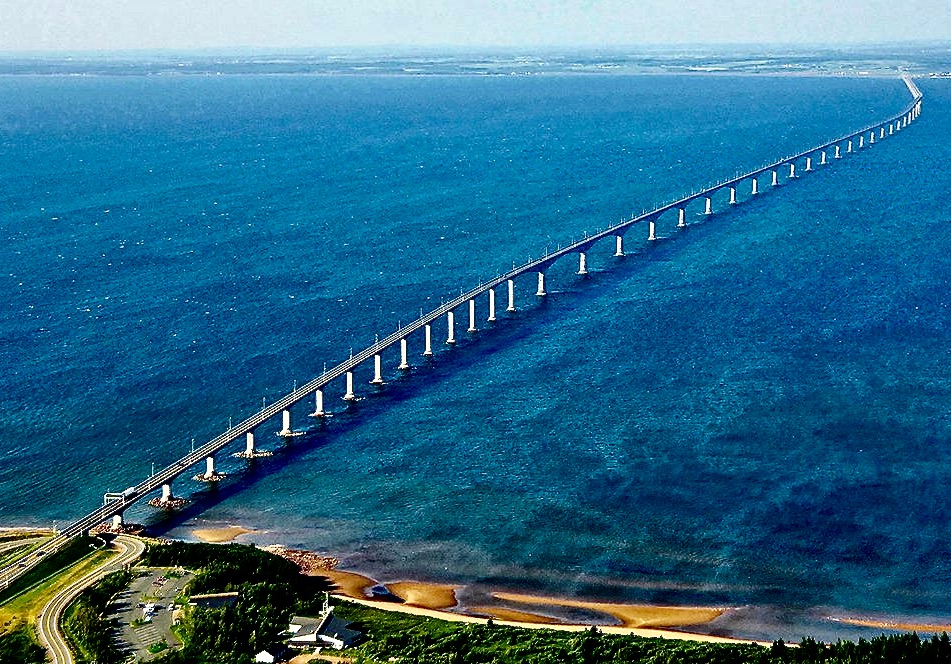
   They drove east past Woodstock, Frederickton, and Moncton. When they got to Sackville they stopped for a bite to eat at the Cackling Goose Market. An hour later they were at the Confederation Bridge. Before 1993 the only way to get to and leave the island was by car ferry. After 1993 there was the bridge. It is a nearly 8-mile long box girder bridge carrying the Trans-Canada Highway across the Abegweit Passage of the Northumberland Strait, linking Prince Edward Island with the mainland. It is the same length as 117 football fields. It weighs almost 8 billion pounds. The average person weighs about 150 pounds so the bridge equals 50,000,000 people.

   “That’s a mighty big bridge!” Emma said.

   “And long, too,” Oliver said.

   They got to North Rustico on the north side of the island before dusk. They were going to stay in one of the cottages at the Coastline Cottages just outside of town on the coast of the Gulf of St. Lawrence. When they drove up the long drive they passed a kidney-shaped salt water pool.

   “You didn’t tell us they had a swimming pool!” Oliver and Emma exclaimed at the same time. 

   “They do and it’s open every day it doesn’t rain.”

   “Does it rain much?”

   “Not too much.”

   “Woohoo!”

Ed Staskus posts monthly on 147 Stanley Street http://www.147stanleystreet.com, Made in Cleveland http://www.clevelandohiodaybook.com, Down East http://www.redroadpei.com, and Lithuanian Journal http://www.lithuanianjournal.com.

“Ebb Tide” by Ed Staskus

“A stem-winder in the Maritimes.” Sam Winchell, Beyond Fiction

Available at Amazon: https://www.amazon.com/dp/B0CVDP8B58

Summer 1989. A small town on Prince Edward Island. Mob money in transit gone missing. Two hired guns from Montreal. One RCMP officer stands in their way.

A Crying of Lot 49 Publication

Sympathy for the Devil

By Ed Staskus

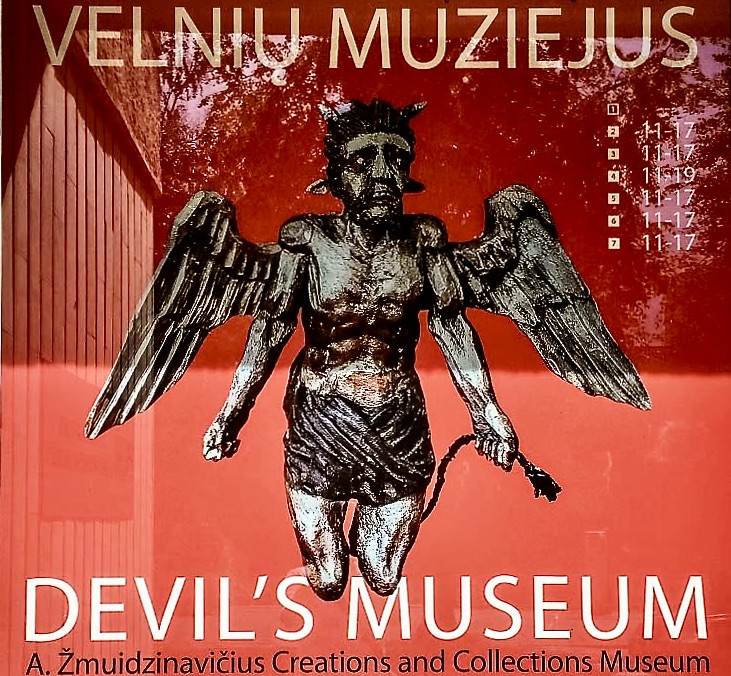
   There was a line waiting for the museum to open. The line snaking its way to the front door was at the Žmuidzinavičius Museumotherwise known as the Devil’s Museum. It was dedicated to collecting and exhibiting fiendish sculptures and carvings from around the world. It was the place to get up close and personal with Satan. 

   The collection was started as a sideline by the artist Antanas Žmuidzinavičius. One of his first collected sculptures was the Trampled Devil, given to him by a priest in 1908. The sculpture had been so big the priest couldn’t move it, so he sawed it in half. He kept the half that was Saint Michael Archangel, who had been doing the  trampling. The museum got the other half. 

   The hall of fame was established in the artist’s home after his death in 1966. There were 260 sculptures in the collection then. Before long, museum goers began to donate their own devils, leaving them in the vestibule. By 1982 a three-story extension had to be built to house the ever-growing accumulation. By the time Oliver and his father went to the museum it had grown to more than 3,000 items.

   Oliver was the Monster Hunter of Lake County. He lived in Perry, Ohio, near Cleveland. He was on his summer vacation. He was far away from home in Lithuania with his father, who was on a working trip with a three-man electrical engineering team tasked with improving the workings of the Heat and Power Plant of Kaunas.

   Most of the devils in the museum are sculptures in wood or ceramic. Some are stone, almost as immutable as evil. Others are masks or paintings. Some are made of silk, paper, or canvas. They are from all around the world, from many different times and places. The devil has always sat on mankind’s left shoulder.

   A cluster of older men was in front of Oliver and his father, who were in the middle of the line. One of them blew his runny nose. Another one snorted like a tired walrus. The men were Mao Zedong, Adolf Hitler, Joseph Stalin, Pol Pot, Saddam Hussein, Vladimir Putin, and the Apprentice. They were the kind of men who let the devil use their brain pans as a garbage dump. 

   Putin and the Apprentice were standing shoulder to shoulder, except the Apprentice was half a step behind the Russian strongman. That was the way the strongman wanted it. The Apprentice was an orange-skinned old man who spoke in riddles and wanted to be a tyrant so bad he could spit. He shifted his weight from one foot to the other. He couldn’t wait for the museum to open. He had to go to the bathroom bad. He didn’t want to pee in his pants. That would be VERY BAD!

   “Why is this always happening to me?” he complained. “I made my deal with the devil. Why can’t he take care of the details? On top of that, why can’t he deliver a younger stormy girl to my hotel room, where they have bathrooms only a step away?”

   No matter what, though, he knew he wasn’t getting his soul back anytime soon. He knew how spin falsehoods like nobody’s business, so much so that he had climbed the ladder of them to the highest places in society. He was shrewd enough to not believe his own lies, however, unless they personally benefitted him. He was loyal to one man only, and that was himself. Everybody else found out sooner or later that the Apprentice’s loyalty street was a one-way street.

   Oliver wasn’t interested in the Devil’s Museum for art’s sake. He was interested in it because he needed to know as much about monsters as possible if he was going to go nose-to-nose with them. One of his cranky uncles had told him, “Keep your friends close, but your enemies closer.” His other cranky uncle said, “Don’t pay attention to that blowhard.” Oliver wasn’t sure what it all meant, but his enemies in the monster world could be beyond cranky, so he always kept their wrong side at the front side of his mind.

   The doors of the museum opened. The line began to inch forward. Oliver noticed something odd about the group of old men in front of him. They were walking in single file, each man holding onto the shoulder of the man in front of him. He had seen a cartoon like that once. He wondered if they were blind. When the group of old men paused to have their tickets validated, Oliver slipped in front of Adolf Hitler, who was the point man, and waved his hand in front of Der Fuhrer’s face. The despot’s toothbrush mustache twitched but his eyes stayed focused on nothing.

   “Dad, I think those men are all blind.”

   “That’s too bad but be good and don’t bother them.”

   The devil appears in more than five thousand Lithuanian yarns and fairy tales. There are more than a thousand names for him in the Lithuanian language, names like Kipšas, which means the dickens, Pinčiukas, which means the deuce, and Bekelnis, which means without pants. There are more than four hundred place names in Lithuania related to the devil, places like Velnio Duobė, which means the Devil’s Hole, Velniaraistis, which means the Devil’s Bog, and Velniabalė, which means the Devil’s Swamp. 

   The ground floor had folk art devil souvenirs galore, medals, masks, sculptures, ceramics, candlesticks, whistles, calendars, and coffee mugs. They made great gifts. After giving everything a once-over, Oliver went upstairs. All the objects upstairs had been created by folk craftsmen and professional artists. On the third floor were devils left by foreigners from American, Asian, and African countries. They were displayed according to their country of origin. One sculpture depicted Adolf Hitler and Joseph Stalin doing a dance of death over a pile of bones.

   When Oliver went back down to the ground floor, he saw the seven blind autocrats doing an awkward line dance like seven dwarfs on magic mushrooms. Adolf Hitler led the jig parade, the rest of the men following his lead as best they could and doing their own madcap high stepping. Mao Zedong whooped it up in tongues while Joseph Stalin cracked a smile, the first in more than half a century. They seemed to be having a good time.

   “The jig is up!” a voice called out. It was Satan, the one and only, in the flesh. He was wearing a top hat that concealed his horns. “This is the thanks I get for giving you a half-day off?” he thundered, waving his sword cane.

   “The devil made me do it,” the Apprentice said, parroting Flip Wilson and pointing in all directions. “Everybody is against me. It is so unfair!” He was panting and his face was flushed. His damp hair hung down his forehead.

   “This is a house of worship, not a honky-tonk,” Satan said. “Your time is over. I want all of you out of here right now!”

   A back door opened seemingly on its own. The line of men went out the door, each of them holding onto the shoulder of the man in front of him. No sooner were they in the back alley than a sewer grate picked itself up and rolled to the side. Adolf Hitler unwittingly stepped into the open sewer hole and toppled down into it. The rest of the line followed him like lemmings. They went down the sulphury brimstone hole one after the other.

   When the back door slammed itself shut Satan turned to see Oliver looking up at him.

   “Hell’s bells, if it isn’t the little monster hunter from Ohio,” he said.

   “I’m big enough to stand up for myself,” Oliver said,

   “Big talk from a small fry,” Satan said and reached down to poke him in the eye.

   Oliver kicked him in the shin. 

   “That hurt, you wicked boy,” Satan said. He shape-shifted into a goat and tried to head butt Oliver. 

   The devil wasn’t scared of anything except the cross and the rosary and some other things, like Saint Michael. He was rattled by prayers even though he needed prayers more than anybody in the universe. He was spooked by flax, wild ash, consecrated water, and the number one. Oliver raised his forefinger making the sign of the number one. The goat bleated and backed away.

   “My mom says don’t open the door to the devil,” Oliver said.

   “I say the devil’s voice is sweet to hear,” Satan said.

   “Tell the truth and shame the devil,” Oliver said. “You are sour. You don’t know how to sing, only howl.”

   “You are driving me to distraction,” Satan said.

   “Go distract yourself somewhere else, like Mars,” Oliver said.

   Satan snorted, breathing fire.

   “Go away,” Oliver said.

   “Who were you talking to?” Oliver’s father asked, walking up as the devil walked away. Satan knew there were second chances all around the world.

   “Nobody, dad. Can we go get a sweet treat?”

   “Yes, let’s go to Gelato Archie and cool off. It’s hot in here.”

Ed Staskus posts monthly on 147 Stanley Street http://www.147stanleystreet.com, Made in Cleveland http://www.clevelandohiodaybook.com, Atlantic Canada http://www.redroadpei.com, and Lithuanian Journal http://www.lithuanianjournal.com

“Ebb Tide” by Ed Staskus

“A stem-winder in the Maritimes.” Sam Winchell, Beyond Fiction

Available at Amazon: https://www.amazon.com/dp/B0CVDP8B58

A small town on Prince Edward Island. Summer 1989. A missing rucksack full of one hundred dollar bills. Two hired guns from Montreal. One RCMP officer stands in their way.

A Crying of Lot 49 Publication

Snake in the Grass

By Ed Staskus

   Oliver and his father were at Meinrage Beach, just north of Klaipeda and south of the Giruliai Nudist Beach. It was a week after they had arrived in Lithuania. Meinrage means mirage in German. Klaipeda is a port city on Lithuania’s western border with Germany. It wasn’t always a Lithuanian city. When it was sauerkraut land it was called Memel. After World War One the city and its surrounding district were split off from Prussia by the Treaty of Versailles. Lithuania annexed all of it in 1923.

   The boy and his father had left Kaunas at sunrise at 5:30 in the morning. It took them less than three hours to drive to the shore of the Baltic Sea. It was a fine Saturday, warm and sunny. The sun wouldn’t be setting until after 9:30, making it a long fine Saturday. They stopped at the beach near the spit to sit in the sun. Oliver thought they might visit the Hill of Witches on the other side of town. It was a museum of wooden sculptures, full of devils and witches.

   Oliver was nine and  half years old. He was the Monster Hunter of Lake County. He lived in Perry, Ohio, west of Cleveland, with his sister Emma, mother, and father. His father was an electrical engineer who had been sent as part of a three-man team to the Heat and Power Plant of Kaunas to help modernize it. Oliver had tagged along, being on summer vacation.

   His father was partly Transylvanian Saxon and partly Lithuanian. He spoke enough Lithuanian to get by. He didn’t speak Transylvanian or Saxon. Oliver’s forebears had been from central Romania, where Saxon farmers and fighting men had emigrated 700 years earlier. Transylvania is known for mountains, medieval towns, and castles like Bran Castle, a fortress linked to the legend of Dracula. His grandfather had lived in Brașov, which featured thick walls and bastions, as well as the  Black Church. The Saxon churches were fortified in case prayer didn’t prove effective against Muslim marauders. 

   His grandmother had come from the Baltics. She was from the small town of Rokiskis near the Latvian border. She was born just after World War Two broke out. Her family fled their home in 1944, never to return, eventually making their way to the United States. Oliver’s grandparents met, got married, and set up shop on the ethnic east side of Cleveland.

   His father was taking a nap on a green blanket spread out on the white sand when Oliver went for a walk. He waked along the seashore, up a dune, down another dune, and ran through the surf. On the way back he noticed five solitary trees standing in a row at the far side of the beach. The trees were five different kinds. He went over to them, curious why five of them would be in a row. A creek came out of the woods there and drained into the Baltic Sea. The trees had all the fresh water they needed at their feet.

   One was an oak tree, one was an ash tree, one was a birch, one was an aspen, and one was a spruce. He looked up at the spruce tree when it began to talk to him.

   “Young man, do you know any spells or incantations that will restore me and my family to human life?”

   “I might,” Oliver said. “Were you people once?”

   “Yes,” the spruce tree said. 

   “What happened?’ Oliver asked. “How did you become trees?”

   “It was a warm and sunny day, just like this day,” the spruce tree said. “I was swimming here with my two sisters. When we returned to the shore to get dressed, I found a snake in my clothes. The snake spoke to me in a man’s voice. He promised to return my clothes if I promised to marry him. I needed my clothes. I couldn’t go naked. I said I would marry him. Three days later a knot of snakes in a wagon showed up at my parent’s farm. They came to claim me. Their leader said, ‘We are here to take Egle to our master.’ My parents tried to trick him by giving him one of our farm animals, but a bird of passage warned the snake about the trickery. In the end they wound themselves tightly around me and took me away.”

   “I’m iffy about snakes,” Oliver said. “Even when they’re not poisonous they can be venomous.”

   “They took me to the seashore where I met Žilvinas, who was the Snake King,” Egle said, ignoring Oliver’s observation. “He was young and handsome. He took me to an island and then to his palace under the water. We got married and lived happily. We had three sons, Ažuolas, Uosis, and Beržas, and a daughter, Drebulė.

   “The children started asking about my former home above the water. I became homesick and asked my husband to let me and our children visit my parent’s farm. He was against it and set many impossible conditions, which were to spin a never-ending mound of silk, to wear out a pair of iron shoes, and to bake a pie without kitchen utensils. A kind sorceress helped me accomplish all the conditions and my husband had to let me and our children go.

   “Our reunion was a happy one. We stayed for a month. When time came to return to our underwater palace, my parents did not want to let me go. They decided to kill Žilvinas. They needed to find out how to get him to come up from the sea. I wouldn’t tell them. They insisted my children reveal the secret. My sons refused to tell them, but my daughter got scared and told them the secret.”

   “What happened when they found out?” Oliver asked.

   “I had twelve brothers. They got their scythes and marched to the seashore. They had an evil plan. They called for Žilvinas with the secret words they had wrested from Drebule. My husband appeared in the form of a snake and my twelve brothers hacked him to pieces with their scythes. When they got back to my parent’s farm they didn’t say a word about what they had done.

   “The next day, ending our stay, my children and I went  to the seashore and called for Žilvinas. The only answer we got was a bloody foam that appeared at our feet. I realized my husband was dead. In my grief I summoned my kind sorceress and she transformed us into trees. My sons became an oak, an ash, and a birch, and my daughter became an aspen. I became a spruce.”

   “Why don’t you ask your sorceress friend to help you?” Oliver asked.

   “She has disappeared off the face of the earth,” Egle said. “Nobody has been able to help us these many long years.”

   “OK, I’ll try “ Oliver said.

   He knew an incantation he had learned from the honey badger who lived in the woods behind their house in Perry, Ohio. The honey badger used the incantation whenever he was bitten by a snake. It always worked. He always shook off the venom. He was hale and hearty and planned to stay that way.

   Oliver spread a black cloth on the ground in front of the trees. He cast a circle. He placed water, earth, incense, and a white candle on the cloth. He lit the candle. “I call upon every force I have come to know, water, earth,  fire, and air, the gods and goddesses and their fairies, the powers within myself and the powers within Egle, help her and her sons and her daughter become as they were. This is my will. So may it be done.”

   He stepped in front of the trees one after the other and set them on fire with his candle. All five of them were an inferno within minutes. The next minute Egle and her sons and daughter stepped out from the flames transformed into the selves they had once been.

   “Aciu,” Egle said.

   “All in a day’s work,” Oliver said as the smoke cleared.

   When they were gone Oliver felt like it had all been a mirage, except he still had the white candle in his hand. He blew it out. It had thrown its fire and light far. It was how good deeds shine in a wicked world.

Ed Staskus posts monthly on 147 Stanley Street http://www.147stanleystreet.com, Made in Cleveland http://www.clevelandohiodaybook.com, Atlantic Canada http://www.redroadpei.com, and Lithuanian Journal http://www.lithuanianjournal.com

“Ebb Tide” by Ed Staskus

“A stem-winder in the Maritimes.” Sam Winchell, Beyond Fiction

Available at Amazon: https://www.amazon.com/dp/B0CVDP8B58

Atlantic Canada, 1989. A small town on the Gulf of St. Lawrence. A missing satchel full of one hundred dollar bills. Two hired guns from Montreal. One RCMP corporal stands in their way.

A Crying of Lot 49 Publication

Burn After Reading

By Ed Staskus

   Oliver’s grandmother, who was 18 years younger than his grandfather, had a younger brother living in Kaunas. The city is in south-central Lithuania where the Neris and Nemunas rivers meet. Kaunas Castle is a still-standing medieval fortress. Kaunas Cathedral Basilica is in the old town. Laisvės Aleja crosses the city from east to west. It is a pedestrian-style street lined with cafes shady under a canopy of trees.

   The younger brother was a middle-aged man with a family. They lived in a small house with not enough bedrooms. It was on the outskirts of the city, in Uzliedziai near the main roadway. Oliver and his father visited him on Sunday, a day after arriving from the United States.

   Oliver was the Monster Hunter of Lake County, where he and his family lived not far from Cleveland, Ohio. His father was an electrical engineer. He was in Lithuania with a three-man team working on an improvement project at the Heat and Power Plant of Kaunas. Since it was his summer vacation, Oliver had tagged along with his father.

   Sigitas was the younger brother’s name. He was a construction foreman, short and stocky, had forearms like a blacksmith, and wore his hair like a military man, which he had once been. His wife was short and stocky like him. Her name was Ona. She wore her hair in a bun. They had four children. Three of them were teenagers. One of them was a child.

   Oliver and his father got lost going to Uzliedziai and were late for lunch. The family was already at the dining room table when they got there. Sigitas was sitting at the head of the table, Ona opposite him, the oldest son to his father’s right, and the rest of the brood catch-as-catch-can. Lunch was cold beetroot soup and curd pancakes. The soup had pickled cucumbers and chopped hard-boiled eggs in it. The curd pancakes were eggs, dry crumbled cottage cheese, and sour cream, along with flour, sugar, and salt. Bilberry and raspberry jam were on the side. 

   After lunch Sigtas, Ona, Oliver, and Oliver’s father sat on the front porch. Sigitas had a bottle of Svyturys Ekstra beer. Ona had a glass of Vyritas, a honey liqueur, while Oliver and his father had cold cans of Kvass, a non-alcoholic beer made from barley malt. Oliver’s father thought it tasted like a cross between beer and kombucha. Oliver thought it tasted sparkly tart. Ona didn’t speak a word of English, but Sigitas made up for her. He spoke English well enough and translated what was said to his wife.

   When he told her what Oliver had said about hunting monsters at home in Ohio her ears pricked up. She said something to Sigitas who then said it to Oliver.

   “Do you think you could help us with a problem we are having?”

   “I could try,” Oliver said. “What is the problem?” 

   “Baubas is the problem.”

   “What is Baubas?” Oliver asked.

   “Baubas is an evil spirit,”  Sigitas said. “He is a black and dark creature. He has long arms, claw fingers, and red eyes. He lives on mold and fungus. He hides in basements, under carpets, and hidden spots of the house. He harasses the young and tears their hair out. He is like your boogeyman. Parents tell their misbehaving children, ‘Behave, or Baubas will come and get you.’ It’s been said he steals bad children and takes them away, never to be seen again.”

   In Germany Baubas is the butzemann. In Poland he is the bida. In Spain he is El Bolo. He is here there and everywhere. He is the black sheep of the family.

   “Has Baubas been bothering your family?” Oliver asked.

   “Only our youngest girl. The others don’t believe in bogeymen.”

   “Has the girl been bad?”

   “No, not at all, unless she’s been bad in her thoughts.”

   “Maybe Baubas picked the wrong little girl to bother.”

   “We think Baubas is trying to make her be bad,” Sigitas said. “He hasn’t been harassing our Daiva or tearing her hair out. Instead, he’s been hiding under her bed and sneaking into her dreams.”

   “Oh, that’s bad,” Oliver said. “He’s getting into her brain. Has he been leaving a book for her to read in bed before she goes to sleep.”

   “She has a new book she found somewhere. It’s a pop-up storybook. She reads it every night.”

   “That’s how he’s getting into her dreams,” Oliver said.

   “We don’t like the book. Some of the pop-ups are of Baubas saying ‘Let me in!’ Whenever we find it we throw it away but every day it’s under Daiva’s bed again. Every night in the  middle of the night she wakes up screaming.”

   “Since the book seems like it is problem No. 1, we can do what they do where I come from, which is either ban it or burn it.”

   “I thought America believed in free speech,” Sigitas said.

   Oliver’s father snorted. “It depends on what America you are talking about. If it’s Vermont or California, book banning is banned. If it’s Texas or Florida, ‘the children’s book ‘Charlotte’s Web’ is banned. If it’s the book ‘1984’ it’s banned everywhere in the South. It’s the most banned book in America. ‘Mein Kampf’ isn’t banned anywhere, believe it or not. Some school boards in Virginia want to burn books and never mind the banning.”

    “That is what the Nazi’s used to do,” Sigitas said.

   “I’m afraid we are going to have to burn Baubas’s pop-up book if we can find it. Do you know where it is?” Oliver asked.

   “I threw it in the trash this morning.”

   When they looked in the trash it wasn’t there. When they looked under Daiva’s bed it was there again. Oliver belly crawled under her bed and retrieved it. He turned the pages. They were soiled and greasy. 

   “Baubas has got himself all puffed up,” he said, showing them a page that said, “You cannot get rid of me!” Oliver knew it was bravado, but a Russian roulette kind of bravado. “We are going to have to burn this book and bury the ashes in twelve different spots in a forest. When we bury the ashes we are going to have to burn a sprig of sage over every one of the spots.”

   They drove to a secluded spot in the Babtu-Varluvos forest. They first stood in a circle in a parking lot while Ona burned the book. A curious park ranger watched from a distance. Sigitas had brought a pail and shovel. Oliver’s father had brought a bag of sage. They carried the ashes in the pail and buried them in twelve scattered spots. They waved burning sprigs of sage over every spot. When they were done a hot wind blew through the trees. They returned to Udliedziai in silence.

   When they got back, pulling up to the house, they saw Baubas walking away with a bindle over his shoulder. The stick was hazel wood with a sack at the end of it.  The sack was made out of rags. They could see bones sticking out of it. Baubas gave them a sour look. He didn’t say goodbye.

   “There goes the pop-up nightmare,” Oliver said.

   “Sudievo, velnio ishpera,” Sigitas said. “Nesiartink.”

   “Amen to that,” Oliver’s father said.

Ed Staskus posts monthly on 147 Stanley Street http://www.147stanleystreet.com, Made in Cleveland http://www.clevelandohiodaybook.com, Atlantic Canada http://www.redroadpei.com, and Lithuanian Journal http://www.lithuanianjournal.com

“Ebb Tide” by Ed Staskus

“A stem-winder in the Maritimes.” Sam Winchell, Beyond Fiction

Available at Amazon: https://www.amazon.com/dp/B0CVDP8B58

Atlantic Canada, 1989. A small town on the Gulf of St. Lawrence. A satchel of counterfeit money. Two contract killers from Montreal. One RCMP gravel road cop stands in their way.

A Crying of Lot 49 Publication

Leaving On A Jet Plane

By Ed Staskus

   “Mom told me dad is taking you to Lithuania next week,” Emma said. It was Monday morning, two weeks before the end of school and the start of summer. Emma was at the breakfast table and had a bowl of Honey Bunches of Oats in front of her. Oliver had a PB&J sandwich on a dessert plate in front of him.

   “That’s right, we’re leaving on Friday after this Friday, as soon as the last day of school is over,” Oliver said.

   “What about me?” 

   “What about you?”

   “What about me going?”

   “You’re going somewhere the next day, on Saturday, except you’re going to piano camp.”

   “Piano camp?”

   “It’s in Oberlin, not too far away. Tommy One Shoe said it’s a nice drive. Didn’t mom tell you?”

   “No, she hasn’t said anything about it. How do you and Tommy know about it and I don’t?”

   “Maybe mom wants to surprise you.” 

   “Surprise me? I don’t like surprises. I don’t even like the piano anymore, either. I’ve been playing the clarinet in the school band all year. I like the clarinet. It’s my thing.” She had been listening to Benny Goodman on iTunes on their mother’s cell phone. Neither she nor Oliver were allowed to have their own cell phones.

   “Maybe she will send you to a clarinet camp next.”

   “What? I don’t want to go to any old music camp. I want to go with you and dad.”

   Oliver was the Monster Hunter of Lake County. He was nine and a half years old. Emma was his sister. She was his right-hand man when it came to hunting monsters. She would be twelve years old a few weeks before summer ended. 

   Their mother had been a corporate lawyer, but after Oliver and Emma were born she became a homemaker. Their father was an electrical engineer. Oliver and Emma were part Lithuanian and part Transylvanian Saxon on their father’s side. They were part German and Scottish on their mother’s side. 

   Their father was going to Lithuania as part of a three-man team to inspect  and recommend improvements at the Heat and Power Plant in Kaunas. His company had developed new software for the job. He was an excellent electrical engineer and a fair speaker of the Lithuanian language, which was why he had been chosen for the job. He had plenty of frequent flier miles and when he asked Oliver if he wanted to go with him, Oliver jumped at the chance.

   Emma complained long and loud about having to go to piano camp. She complained even more about not going to Lithuania. She complained bitterly about Oliver going instead of her. After all, she was older and smarter than him. She loved history. She loved culture. She should be the one going to Europe. Oliver wouldn’t know culture if he tripped over it. Even he admitted she was the brains behind their monster hunting. Oliver had true grit, but she had the brain cells.

   Their father finally sat her down. “I can only take one of you, bunny,” he said. “Besides, your mother has her heart set on you going to the piano camp, which is at the same time. I have good news, though. We have been thinking about going to Prince Edward Island for two weeks before school starts. Would you like that?”

   “Yes dad, I really would.”

   Emma had read “Anne of Green Gables” that winter and liked it so much she had read two more of the Green Gable books.

   “Can we go to Cavendish where Anne lived?”

   “That’s exactly where your mother and I are thinking of renting a cottage.”

   “Oh, that would be so great,” Emma said.

   Oliver had never flown on a jet. He was excited about it. He sang “Leaving On a Jet Plane” all the way to the airport.  “All my bags are packed. I’m ready to go, “cause I’m leavin’ on a jet plane, don’t know when I’ll be back again.”  Those were the only lyrics he knew. He sang them again and again until his father asked him to stop.

    His father and he flew United Airlines from Cleveland Hopkins Airport to Washington, D. C. and from there to Denmark. Goo Goo Godzilla, who was the grandson of Godzilla, rode shotgun, hitching a ride on top of the plane. The monster and  Oliver had gone nose to nose at the Perry Nuclear Power Plant three years earlier when Oliver was six and just getting started in monster hunting. The power plant was within bicycle distance of where they lived in Perry. He had saved the day by convincing Goo Goo it was in his best interest to leave it alone rather than destroying it.  When Oliver looked out his porthole he could see Goo Goo’s shadow on the wing. He knew the kaiju was watching out for him.

   It took ten hours to get to Denmark. They landed in Copenhagen. Goo Goo took off for Paris where he was going to be the Grand Marshall of a Godzilla Day Parade on the Avenue des Champs-Elysees. Oliver and his father had chicken sandwiches at Cocks & Cows near Gate B. After they ate they walked from one end of the terminal to the other until they realized their flight to Vilnius was leaving soon. They had to run to make it. 

   The flight to Lithuania was going to take an hour and a half. Vilnius was the capital of the country. Oliver sat at the porthole and his father sat in the aisle seat. The middle seat was empty. When a young girl with long black hair, her ponytail held in place not by an elastic tie or a barrette but by a swan’s feather, asked if she could sit in the middle seat, Oliver gestured at the seat in a friendly way. She sat down.

   “You look familiar,” Oliver said. “Are you the Marsh King’s daughter?”

   “Yes, I am,” she said.

   “I’m happy to meet you,” Oliver said putting his hand out to shake hands. They shook hands.

   “I heard about how you saved your father when he was turned into a tree stump,” Oliver said. The Marsh King ruled the underground realm beneath the moorlands in the north of Jutland. The moorlands extended for many miles. It used to be overrun with wolves and was still overrun by damp mist. It was surrounded by swamps and marshy ground. Anybody stepping on the wrong spot sank and went down to the Marsh King.

   “He had come up from beneath the moorlands to find bilberry to cure his diarrhea,” the Marsh King’s daughter said. “The three moorland witches saw him and cast a spell. They transformed him onto a tree stump. He tried to push himself back  down into the slime, but couldn’t.”

   The Marsh King’s daughter was standing at the base of the tree stump wondering what to do when a flock of storks darkened the sky and landed all round her. The stork parents rested while the stork girls strutted and caught small snakes with their beaks. The stork boys looked for frogs and swallowed them whole. They started quarreling, batting each other with their wings and pecking.

   “When I saw that I collected a basket full of frogs and emptied it on top of the tree stump. The stork boys rushed to the tree stump and fought for the frogs. Before long blood was dripping all over the tree stump. While the blood was still warm I said the magic words my mother had taught me.” 

   “What are those words?” Oliver asked.

   “Out of dislocation and into realignment, out of disorder and into order, bone to bone, joint to joint, as it was best when it was whole.”

   “What happened then?”

   “The tree stump shook itself violently until arms and legs pushed themselves out from it. I saw my father’s face come to life. His head twisted itself out of the top of the stump. The storks backed away. In a minute the tree stump was gone and my father was alive and well again. We held hands and went back together, back to our home beneath the moorlands.”

   “Are you going to Lithuania like me?”

   “Yes, my sister invited me to visit her. She has a cottage on the Corinthian Spit. She said I could stay all summer and get some sun. We don’t see much sun under the moorlands.”

   Oliver felt the jet plane turn and tilt towards the Vilnius airport. “I’m going to be in Lithuania for two weeks. Maybe we’ll meet again,” he said.

   “I have a spell for that, to make it happen,” the Marsh King’s daughter said, looking impish.

   “That’s OK.” Oliver said. “Wherever I am is where I am. I’m not a big fan of spells, unless it’s an emergency. If I see a sign for the Curonian Spit I’ll stop  by.” He waved goodbye to the Marsh Princess as he joined his father and stepped on Lithuanian soil for the first time in his life.

Ed Staskus posts monthly on 147 Stanley Street http://www.147stanleystreet.com, Made in Cleveland http://www.clevelandohiodaybook.com, Atlantic Canada http://www.redroadpei.com, and Lithuanian Journal http://www.lithuanianjournal.com

“Ebb Tide” by Ed Staskus

“A big story in a small town.” Barron Cannon, Adventure Books

“A stem-winder in the Maritimes,” Sam Winchell, Beyond Fiction

Available from Amazon: https://www.amazon.com/dp/B0CVDP8B58

Atlantic Canada, 1989. A town on the Gulf of St. Lawrence. A satchel of stolen counterfeit money. Two contract killers from Montreal. One RCMP gravel road cop stands in their way.

A Crying of Lot 49 Publication

Batteries Not Included

By Ed Staskus

   The week Oliver turned nine was the same week his grandfather turned ninety. His father, who was the son of his grandfather, threw a party on the back patio and grilled dogs, hamburgers, and corn on the cob. His sister Emma, his right-hand man when they got down to the monster hunting business, made a chiffon cake. She was eleven and a half and had been baking since she was eight years old. She was an old hand at it.

   Chiffon cake is a mix of an oil and sponge cake. The oil makes it lavish and whipped egg whites and baking powder make it airy and light. Birthday cakes go back to the Roman days. Back then fried bread was the order of the day since it is cake-like sweet. Special days aren’t complete without something sweet and yummy.

   Emma was a blue moon baby. She had been born on the 1st of September under a full moon. The day the month ended there was another full moon. She claimed she should have two birthdays and two parties every year. “My policy on birthday cakes is pro about eating as much as I can,” she said. Nobody paid any attention to her policies. She sulked as the month came to an unsatisfactory end without more cake.

   Oliver and his grandfather both looked young for their age. “It’s in our genes,” Grandpa Wally said. “Even if it wasn’t, it’s not about counting your years, but making your years count. That’s what I say. That’s what keeps you young at heart.”

   Every day counted with Oliver, too, even rainy days. He looked up at his grandpa, who was looking down at his new Samsung cell phone. He had gotten it the three months before but still didn’t know how all of it worked. He was able to make calls, take pictures, and scroll the internet. He didn’t know how to get to his voice mail or how to look up his pictures. He was on the internet now. He knew how to do that since his get-rich schemes depended on it. Oliver knew it would be a while before he came up for air, so he bent over his paper plate and wondered which end of his hot dog he should start with.

   They were Eisenberg dogs from the Heinen’s grocery store. He knew they were the best wieners in the world and both ends were probably the same. He chomped on the end closest to his mouth. It was more than good. He did some more eating.

   His grandpa had lived a long time. “Nobody has poisoned me, yet,” he said. Oliver knew his mother could poison him as easy as pie if she wanted to. He knew she never would, but who was to say some monster with a grudge against him wasn’t going to sneak into the kitchen when she wasn’t looking and lace his dinner with arsenic?

   He wouldn’t be counting his years if that happened. He would be counting his minutes. He knew his mother would protect him, though. Just in case, he kept antidotes for most of the popular poisons inside an LL Bean personal organizer under his bed.

   His grandpa liked golf, celery and stew, foreign cars, and reliving the past.  He ate celery and stew and drank black strap molasses every morning. He was an immigrant from Romania, popping out of his mother’s belly on the boat to New York City. He liked money but didn’t like the rich. He liked the laws of the land but didn’t like liberal lawmakers, even though they had written Medicare and Social Security into the law of the land. He liked those two laws more than all the others. His Social Security check was very important to him. 

   He didn’t like Jews, even though they were immigrants like him. “The Jews control everything,” Grandpa Wally said. “They keep it in the family. They keep it a secret. Never trust a Jew. They will always screw you. Somebody should do something about it.”

   “Dad, maybe we shouldn’t bring that up about Jews,” Oliver’s father said to his father, nodding at his children.

   “OK, son, OK.”

   Oliver had never seen a Jew unless he had. What did they look like? Did they wear something special? Maybe they kept their Jewishness a secret. If they had all the money, they must be fabulously rich. Every time he saw an expensive car, he thought one of them might be driving it. He looked closely, but every driver he saw looked like they could be one of his neighbors. He made a mental note to look up Jews in the school library.

   His father sat down at the table with Grandpa Wally and Oliver. The sun was hazy in a lemon blue sky. A hot wind was blowing in the late afternoon.

   “It’s been a hot summer,” Oliver’s father said to his father. “Has your air conditioning been holding up?”

   “Sure son, I’m staying cool as a cucumber.”

   “Let me know if anything happens, pop.”

   “I will, thanks.”

   Grandpa Wally had been rolling in dough once, but then got divorced, lost his job, lost his house, and from then on lived in a one room apartment on odds and ends and government money. The family never visited his apartment because Grandpa Wally was a veteran pack rat and another person couldn’t fit under his roof, much less a family of four.

   “Grandpa, is it hard being old?” Oliver asked.

   “It’s hard enough,” he said. “There’s no getting out of the way of it. Everything it does to you is bad, except for some chicken feed of wisdom. You go over the hill and pick up speed on the other side. Old age gets bigger and bigger while you get smaller and smaller. It’s a monster, no place for sissies.”

   Oliver’s ears perked up. Since it was a monster, and since he was a monster hunter, maybe he could help. He had taken care of trolls and kaiju. Old age should be no problem.

   “I could help you fight the monster.”

   “Thanks buddy, but listen up. There’s not much anybody can do. I’ve outlived most of my friends and my health. It’s like being on a boat sailing through a bad storm. Once you’re aboard, there’s nothing you can do except wait for the shipwreck.”

   He looked down at his cell phone and before long was lost in it. His mind had gone one-track lately. His hearing was shot so he listened to himself more than anybody else. He used to walk while playing golf two and three times a week, but now had trouble walking to the grocery, so he drove the half mile there.

   “Isn’t there anything I can do? Emma could help too.”

   “I don’t think so. I’m as active as I can be. I mind my diet, don’t smoke anything or drink booze, and get enough sleep. It’s down the hatch with m tablespoon of black molasses. My coffee klatch gets together and we hash out the world’s problems. I check in with my sawbones. Every day is a good day, although I’m slowly but surely coming apart at the seams.”

   “I feel bad,” Oliver said. “I wish we could help.”

    “Life goes on,” Grandpa Wally said. “Then they throw dirt in your face. Then the worms eat you. I’m happy it’s happening to me in that order.”

   “What will you do at the end of the order?”

   “Don’t worry, I’ll get by. And by the way, when that happens, I’m leaving you the gold pocket watch my father left me. You have to wind it up every day. Batteries not included. It’s got an alarm. When your time has come and it goes off, it gets your attention real fast.”

Ed Staskus posts monthly on 147 Stanley Street http://www.147stanleystreet.com, Made in Cleveland http://www.clevelandohiodaybook.com, Atlantic Canada http://www.redroadpei.com, and Lithuanian Journal http://www.lithuanianjournal.com

“Ebb Tide” by Ed Staskus

“A big story in a small town.” Barron Cannon, Adventure Books

“A stem-winder in the Maritimes,” Sam Winchell, Beyond Fiction

Available at Amazon: https://www.amazon.com/dp/B0CVDP8B58

Atlantic Canada, 1989. A town on the Gulf of St. Lawrence. A satchel of stolen counterfeit money. Two contract killers from Montreal. A gravel road cop stands in their way.

A Crying of Lot 49 Publication