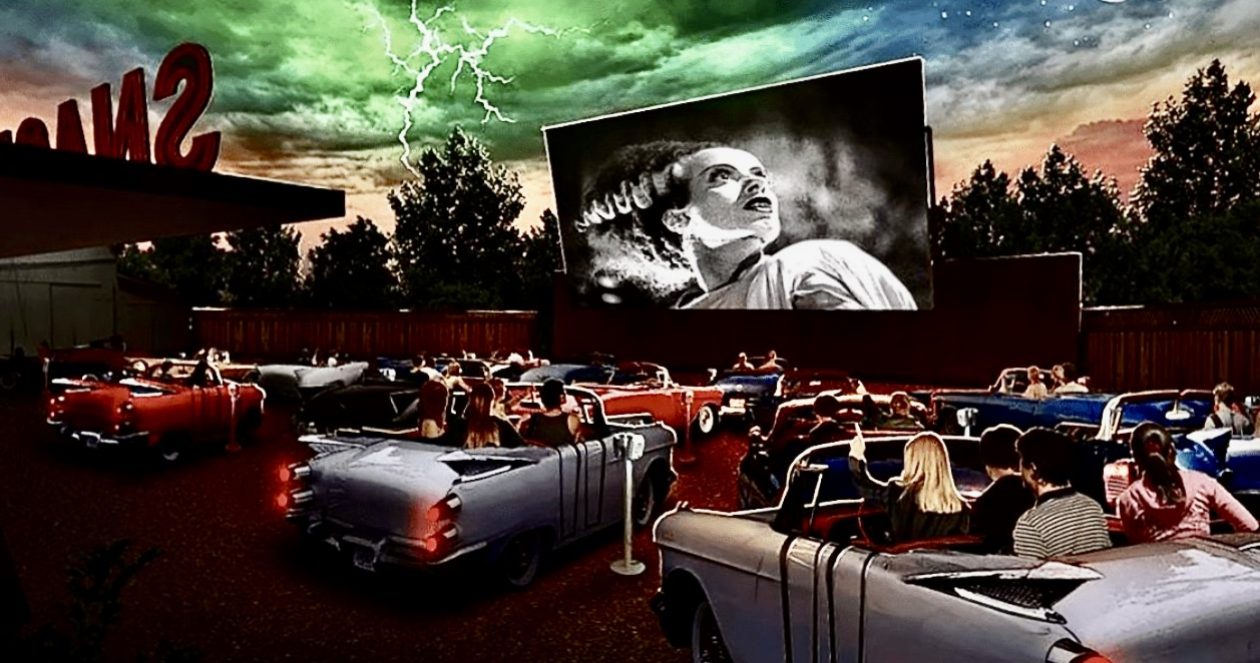
Fixing Frankenstein

By Ed Staskus

   The day Frankenstein walked into Barron Cannon’s yoga studio in Lakewood, Ohio, Barron could tell he wasn’t a happy monster. He walked as though he had never gotten over the rigor mortis of all his lives and deaths before being resurrected by Victor Frankenstein. He was dirty as all get out and wet. His boots were caked with muck and mire. He needed a haircut and a shave. He looked like he could use ten or twelve square meals all at once

   “You look like hell,” Barron said. 

   “I feel like hell,” Frankenstein said.

   “I thought you were dead and gone, and only alive in the movies,” Barron said. “The story is you killed yourself up on the North Pole after Victor died. That would have been a couple hundred years ago.”

   After being chased and pelted with rocks, flaming stave torches shoved into his face, shot at and thrown into chains, Frankenstein had sworn revenge against all mankind. They hated him so he would hate them. He had hated himself, as well, for a long time.

   “I was going to end it all when I floated off on an ice floe, but I froze solid, and it wasn’t until twenty summers ago that I defrosted.”

   A heartwarming result of global warming, Barron thought to himself.

   “After defrosting I lost track of time,” the creature said. “It’s either all day or all night almost all the time. I built an igloo and learned to hunt seals. I caught and beat their brains out with my bare hands. I meant to go back to Geneva. But after living on the ice safe and sound, I changed my mind. There wasn’t anybody anywhere trying to kill me, which was a blessing. But then I got lonely.”

   “How did you get here?” Barron asked.

   “I walked.”

   “It’s got to be three, four thousand miles from the pole to here. How long did it take you?”

   “I meant to go back to Germany, but I took a wrong turn at the top of the world. Canada looked like Russia until I got to Toronto. By then I didn’t want to turn around. I had been at it for five months. I kept walking until I reached Perry, on Lake Erie. I met a boy and girl there. They were riding pedal go-karts on the bluffs. The girl said her brother was the Unofficial Monster Hunter of Lake County. It was hard to believe. He’s nothing more than a tadpole. When I asked him whether he thought I was a monster, he said I looked monstrous, but was sure I wasn’t a monster.”

   Frankenstein had seen his own reflection in water. He was aware of what he looked like. He didn’t like it any more than passersby did, throwing him wary nervous glances and scuttling away. 

   “Was his name Oliver?”

   “Yes.”

   “You didn’t throw him and his sister down a well, or anything like that, did you?”

   “No, and I’m glad I didn’t. They helped me. They gave me some of their homemade granola bars.”

   “Don’t underestimate the boy. He’s taken on banshees and trolls, the 19 virus, Bigfoot, Goo Goo Godzilla, and the King of the Monsters himself. I don’t know how he does it, but he’s no ordinary child to mess with.”

   “He told me to come here and talk to you, that you were a yoga teacher and could unstraighten me. I’m stiff as a board all the time.”

   “I can see that,” Barron said.

   “I want to be able to touch my toes. I want to be a better man.”

   “I can help you with that,” Barron said. “Except the better person part. That’s up to you.”

   “I was benevolent and good once,” Frankenstein said. “Misery made me a fiend. Make me happy, and I shall again be virtuous.”

   “I’ll do my best.”

   For once, Frankenstein had the feeling he had found a true friend.

   After Barron got back from the Goodwill store with XXL shorts and muscle t’s, pants and shirts, and threw away Frankenstein’s clothes, which hadn’t been washed in centuries, they got started on the yoga mat. Barron told him to get barefoot. When he did the smell was bad. Barron turned on the studio’s fans and opened both the front and back doors. He took the creature’s boots outside and tossed them in the dumpster. The dumpster burped and spit the boots back out. They landed in the parking lot with a clomp. Barron doused them with gasoline and burned them.

   “We’ll start with the twelve must-know poses for beginners,” Barron said.

   Frankenstein had no problem doing the mountain and plank poses, but that was the beginning and end of what he could do. He couldn’t do down dog or a lunge to save his life. Triangle, dancer’s pose, and half pigeon pose might as well have been rocket science. When he tried seated forward fold, he folded forward an inch or two and farted.

   “More roughage in those granola bars than you’re used to?”

   “I lived on seal blubber for a long time,” Frankenstein said.

   He could do some of the hardest poses easily, like headstand. He balanced on his flat head like nobody’s business. He chanted like a champ, his baritone voice deep and rich.. He did dead man’s pose like he was born to it. 

   When the lesson was over, however, he wasn’t able to get up out of laydown. His muscles were in knots. Barron pulled out his Theragun and went to work. It took all the percussion device’s battery power to get Frankenstein on his feet and into the storeroom, where Barron prepared a bedroll.

   “It doesn’t look like you’re in any condition to go anywhere, but make sure you stay here. I have three classes back-to-back-to-back. I don’t want you barging through the door and causing any heart attacks.”

   Frankenstein groaned and rolled over. He slept the rest of the day, that night, and part of the next day. Barron took him to the barber shop next door. Frankenstein had never gotten a haircut. His hair was halfway down his back and his beard down to his belly button. The barber gave him a taper fade crew cut and a shave. He trimmed his eyebrows and the tufts of hair growing out of his ears. He unscrewed the electrodes in the creature’s neck.

   The incisions around his neck, wrists, and ankles had long since healed. Barron found a pair of size 34 sneakers and second-hand bifocals for him. Frankenstein was out of practice, but he enjoyed reading. Barron bought two dozen thrillers, biographies, histories at the Friends of the Library sale.

   Monday morning dawned warmand bright. Barron and Frankenstein walked to Lakewood Park, where they could unroll their mats outdoors on the shore of Lake Erie. Barron had sewn two mats together for the big guy. Barron’s one goal was to make the creature more flexible. His unhappiness with the human race would have to wait. He wasn’t killing anybody anymore, at least. Frankenstein’s problem wasn’t a desk job and never exercising. He wasn’t rigid with chronic tension. He had been on an all-blubber diet for decades but enjoyed the plant-based diet Barron was converting him to. They started having breakfast at Cleveland Vegan. 

   He had never stretched in his life, which contributed to his discomfort and stiffness. His poor muscles were as short as could be. On top of everything else he was close to three hundred years old, counting his own lifetime and the lifetimes of the men he was made of. His synovial fluid was thick as mud.

   Barron and Frankenstein worked on standing forward bend hour after hour day after day. At first the creature could only bend slightly, placing his hands on his thighs. He did it a thousand times. He huffed and puffed. When he was able to touch his knees, he did it two thousand times. He broke out into a sweat. One day Barron brought blocks, setting them up on the high level. Frankenstein folded and got his fingertips to the blocks. The day came when Barron flipped them to their lower level.

   “Don’t be a Raggedy Ann doll, just flopping over,” Barron told him. “Do it right.”

   The gold star moment finally arrived when Frankenstein folded forward without blocks. His upper back wasn’t rounded, his chest was open, his legs were straight, and his spine was long. He was engaged but relaxed. He took several steady breaths as the space between his ribs and pelvis grew.

   “Great job, Frank,” Barron said with encouragement.

   Frankenstein did the pose three thousand times. He was looking lean and not so mean. His skin was losing its yellow luster. He was getting a tan in the sunshine at the park. According to B.K.S. Iyengar, Uttanasana slows down the heartbeat, tones the liver spleen kidneys, and rejuvenates the spinal nerves. He explained that after practicing it “one feels calm and cool, the eyes start to glow, and the mind feels at peace.”

   They walked to Mitchell’s Homemade Ice Cream in Rocky River. Barron had a scoop. Frankenstein had eight scoops. Children gathered around him asking a million questions, asking for his autograph, and asking for selfies with him in the picture. He was a ham with glowing eyes and never said no.

   From standing forward bend it was on to more beginner poses, then intermediate poses. By the end of the month Frankenstein wasn’t a yogi, yet, but he was more human than he had ever been. He joined Barron’s regularly scheduled classes. He was two and three feet bigger than anybody else. Barron put him in a back corner by himself where he wouldn’t accidentally clobber anybody while doing sun salutations.

   When the time came for Frankenstein to move out of Barron’s storeroom into his own apartment, Barron made him a gift of B.K.S. Iyengar’s book “Light on Yoga.”

   “This is the book that will make you a better person, Frank. I’ve read it twice.”

   “I’ll read it a hundred times,” Frankenstein said.

   “What do you plan on doing with your life?” Barron asked.

   Frankenstein thought about becoming a barber like the man who tended to him but bending over the tops of heads all day long would lead to lower back pain sooner or later. He knew full well he had arthritis. He threw that idea away. He thought about becoming a house painter. He could reach more areas compared to a shorter man. He could cut in walls and ceilings without using a ladder. That would save hours over the course of a job. The downside was having to paint low, like skirting boards. Stooping would do a number on his back. He threw that idea out the window, too.

   When he finally decided what to do, he was surprised he hadn’t thought of it earlier. It was a natural. It was how he had been granted a second life. He would be become an electrician.

   An electrician is a tradesman who repairs, inspects, and installs wires, fixtures, and equipment. Much of the job involves installing fans and lights into ceilings. Being tall would free him from the need to go up and down a ladder for every install. It turns the work from a two-man job into a one-very-tall-man job. Homeowners in Lakewood were always restoring and upgrading their houses. He would advertise himself as “Call Frank – He Knows the Power of Electricity and Will Save You Money.”

   If he ever made a mistake, he knew he could absorb the bust-up of voltage. He had already been hit with more of the hot stuff than any mortal man and lived to tell the tale. He would look for another Bride of Frankenstein, too, a nice girl with a slam-bam bolt of lightning in her hair. They would make little Frankie’s.

Ed Staskus posts monthly on 147 Stanley Street at http://www.147stanleystreet.com, Made in Cleveland http://www.clevelandohiodaybook.com, Down East http://www.redroadpei.com, and Lithuanian Journal http://www.lithuanianjournal.com. To get the site’s monthly feature in your in-box click on “Follow.”

“Ebb Tide” by Ed Staskus

A Prince Edward Island Thriller

“A stem-winder in the Maritimes.” Sam Winchell, Beyond Fiction

Available at Amazon: https://www.amazon.com/dp/B0CVDP8B58

Summer, 1989. A small town on Prince Edward Island. Mob money on the move gone missing. Two hired guns from Montreal. One RCMP constable stands in the way.

A Crying of Lot 49 Publication
Buckle Hat Hurley

By Ed Staskus

   “Are you OK mister?” Oliver asked, standing in the middle of his backyard, looking at a small man laying at his feet. It was early in the morning. The rising sun was behind him. A slight rain was falling in front of him. He was between the sunshine and the rain.

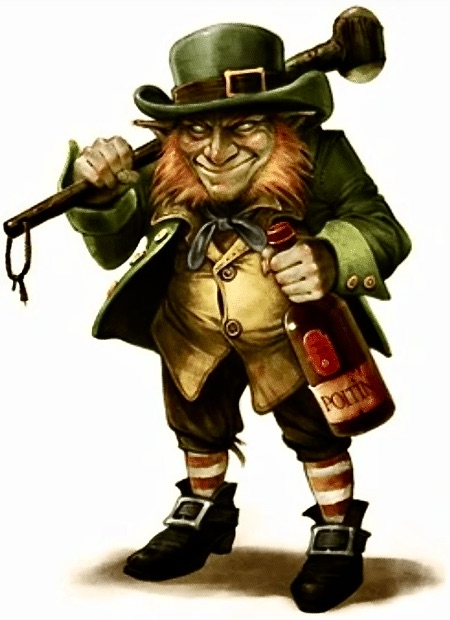
   After a minute went by and there was no answer, he asked the small man again. There was no answer again. Oliver took a closer look at him. He was wearing a buckle hat and breeches. The hat was green and the shoes were black. His breeches were caked with dirt and his sideburns were orangish. The man was flat on his back. He was out cold. A shillelagh was on the ground beside him. He was pint-sized, about Oliver’s size. Oliver got down on his haunches and put his ear near the man’s open mouth. When he heard and felt breathing he felt better. The man was alive, although his breath was foul to the nose. 

   “Mister, are you all right?”

   The small man gurgled in his sleep and shooed away an imaginary fly. Oliver shook the man by his shoulder. Nothing happened. He tried again. Nothing happened again. The third time was the charm, but what happened wasn’t charming. The small man sat bolt upright, hopped to his feet in a flash, and had Oliver in a headlock the next instant.

   Even though Oliver was only nine years old, he knew a thing or two about self-defense. He reached for the small man’s free arm and trapped it between their bodies. He put one foot behind the man and pushed. They both started to fall.  Oliver quickly ducked underneath the head-locking arm and in two seconds flat was behind his assailant. He locked the man’s arm behind his back. They both tumbled to the  ground. When that happened, the small man started snorting and laughing.

   He laughed so much Oliver thought he might choke. He released his arm-lock. Eventually the laughing went its merry way.

   “I will tell you, boyo, nobody has never done that to me. I tip my hat to you.” He reached up and tipped his hat.

   “Who are you?”

   “I’m a leprechaun today, hungover tomorrow, don’t you know?”

   “How did you get here?”

   “Where is here?

   “Perry.”

   “Perry?”

   “Near Painesville.”

   “Painesville?”

   “Near Cleveland.”

   “Now that’s something I do remember, the big parade on St. Patrick’s Day. It’s all a blur after that.”

   “You don’t remember?”

   “I don’t remember anything after the parade except drinking beer in one local after another.”

   “Local?”

   “Where you go to drink beer.”

   “Oh.”

   “All right then, I better be on me way, although I am a wee bit famished.”

   Oliver went into the kitchen and returned with buttered toast, hard boiled eggs, and a bottle of water. The leprechaun chomped on the toast and devoured the eggs. He gave the water a scornful glance.

   “I’ve never met a leprechaun before,” Oliver said. “Do you know Lucky the Leprechaun?”

   “Who’s he?’

   “He’s on every box of Lucky Charms cereal.”

   “Never heard of him.”

   “I was at the St. Patrick’s Day parade yesterday. I didn’t see you.”

   “I didn’t see you either.”

   Oliver and his sister Emma, who was his right-hand man when it came to monster hunting, had been at the parade with their parents and their friend Tommy One-Shoe. The first St. Patrick’s Day parade in Cleveland was in 1842. Since then, all the other big holiday parades in town had come and gone. There wasn’t a Fourth of July or Thanksgiving or Christmas parade anymore, although there was a Turkey Trot. The only one left was the parade in mid-March.

   “Why do you have a little hammer in your back pocket?” Oliver asked.

   “That be my pattern hammer. I’m a shoemaker the same like all leprechauns. We repair shoes for the fairies, who are dancing fools. When they wear their shoes out we make new ones for them. It keeps us busy, believe you me. That’s how we fill our treasure crocks.”

   “What are those?”

   “Our pots of gold.”

   “What do you do with all your gold?”

   “There’s no place for us to spend it so we don’t do anything with it, except avoid big ‘uns who want to get it. They think greed is good. We teach them it’s not good, although they never stop trying to outsmart us. One time a townsman had me dead to rights and would only let me go if I told him where my gold was buried. I pointed to a tree in a field behind him. He took his red suspenders off and tied them around the tree. When he left to get a shovel I disappeared, although I left some of my magic behind. When he got back there was a surprise waiting for him. There were red suspenders tied to every tree in sight.”

   “Where do you come from?”

   “I be from the 8th century.”

   Back in the day leprechauns were water spirits called “luchorpán,” which means small body. The spirits started to befriend household fairies a few centuries later so they could get into cellars where drink was stored. After they tasted the drink they never went back to water. That was when they turned into leprechauns. 

   “Where do you live?”

   “I don’t live anywhere, but where I lay my head is far away.” They didn’t like living in houses, sleeping in caves and hollow tree trunks instead.   

   “Do your friends and family miss you?”

   “No, we be solitary creatures. No friends and no family. I don’t even know if there are or ever were girly leprechauns. There aren’t many of us left, maybe three hundred or so in all of Ireland. It’s gotten so the European Union put us on their protected species list, like we are butterflies or some such thing.”

   “Do you want to stay at our house?” Oliver asked. “We could find a hollow tree trunk for you and we have plenty more toast and eggs.”

   “Thanks laddie, but I needs to be getting back.”

   “How are you going to find your way?”

   “That be easy as raisin pie,” the leprechaun said, pointing skyward. “I look for a rainbow and follow it. My treasure crock lays at the end of the rainbow.”

   It was raining lightly in the direction they were looking.

   “If you want a rainbow, you have to put up with the rain,” the leprechaun said. A rainbow needs water droplets to be floating in the air. That’s why we see them right after it rains. The sun must be behind you for the rainbow to appear in front of you.

   The one they were watching was coming out of the ground on the far side of the Church of Jesus Christ which stood on the near side of Oliver’s backyard. They walked past the house of worship. Oliver didn’t see the small man spit when they passed the Protestant church. When they found the fountainhead of the rainbow they stopped and the leprechaun stood on the spot. The spot was glowing a golden color. The leprechaun started to spin where he stood until like a drill he drilled into the firmament and soon enough was lost to sight.

   Oliver crept to the edge of the hole and cautiously looked down into it. It seemed like he could see to the center of the planet. The leprechaun had disappeared off the face of the earth. When Emma came out of the house to see what was going on, Oliver said, “ I better ask dad to fill up this hole with some dirt before somebody falls in and is gone without a trace.”

Ed Staskus posts monthly on 147 Stanley Street http://www.147stanleystreet.com, Made in Cleveland http://www.clevelandohiodaybook.com, Atlantic Canada http://www.redroadpei.com, and Lithuanian Journal http://www.lithuanianjournal.com

“Cross Walk” by Ed Staskus

A Mid-Century Crime Thriller

“A once upon a crime whodunit.” Barron Cannon, Adventure Books

“Captures the vibe of 1950s NYC.” Sam Winchell, Beyond Fiction

Available on Amazon: https://www.amazon.com/dp/B0CRPSFPKP

Late summer and early autumn. New York City. A Hell’s Kitchen private eye. The 1956 World Series. President Eisenhower at the opening game. A killer in the Brooklyn Dodger dugout.

Mandrake and the Camel

By Ed Staskus

   The first thing the Camel did was head for the back door, being the back door man he was, until he saw Oliver and Emma guarding it. At first, he thought it was some kind of trick Mandrake the Magician had dreamed up. The do-gooder didn’t in his wildest dreams think a couple of pre-teens were going to stop him and his daughter, the Brass Monkey, from escaping the Kirtland Temple and making off with the diamond they had stolen, did he? 

   But then the Camel quickly reconsidered. Mandrake wouldn’t have stationed them there if they were just helpless kids, would he? He asked his daughter. She was puzzled, too, but finally blurted out the kids might be even more dangerous than Mandrake and Lothar. At least they knew what powers the magic man and his African sidekick had, but they didn’t know what the kids had going for them. The Camel didn’t like facing the unknown when it was in his face.

   He and the Brass Monkey ran back up to the top of the tower, When they looked down neither Mandrake nor Lothar were where they had been in front of the front door only a minute earlier. The door was wide open. The Camel realized it was only a matter of a minute before his archenemies barreled out onto the widow’s walk and when that happened there would be hell to pay. He quickly summoned his Three Stooges with special hocus-pocus. They were standing in front him in a flash.

   The Three Stooges were hard men with hard faces. The only candy they ever ate was hard candy. One of them had his teeth professionally polished. They gleamed when he smiled. The other two men never smiled. They didn’t believe in it. They believed in knocking down fairy castles. They didn’t argue their enemies to death with talk.

   No matter how many times the Camel insisted they call him the Master, they refused to do it. The goons called him the Boss and that was that. Two of them were wearing fedoras with contrasting bands. One was hatless. Two of them were carrying handguns. One of them had a .45 Colt and another one had a Colt Officers Special. He had stolen it from a policeman. The hard man wearing a black shirt and green tie was old school. He was carrying a slapper, a leather pouch filled with lead pellets. It was small enough to hide in a sap pocket but big enough to break bones with no trouble.

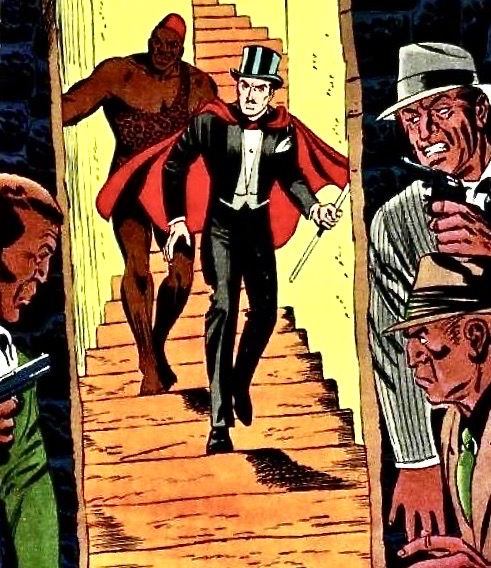
   Mandrake and Lothar strode up the down stairs. The stairs were worn down by time. Their minds were made up. The walls were yellow. When they burst into the open the Three Stooges went to work. The one with the slapper hit Lothar in the face with it as hard as he could, hard enough to buckle the knees of an elephant. Lothar blinked and took the slapper away from the man. He said something the man couldn’t understand. The next thing he knew Lothar was tucking the slapper back into his sap pocket, lifting him over his head, and throwing him off the widow’s walk. He hit the ground like a sack of radishes and stayed where he landed.

   When Oliver and Emma raced to the side of the church, the dust of him hitting the ground was just settling. They checked the man’s pulse. He had one, although at the moment it was going at the speed of a snail. They raced back to the rear of the church.

   “He must have had an accident, don’t you think?” Emma asked her brother.

   “Whatever happened, I don’t think it was an accident,” Oliver told his sister. The next second they heard  gunfire from the temple’s tower. “That is definitely no accident,” Oliver said. The noise was followed by silence. The next thing they knew two guns came flying downwards and thudded on the ground.

   The Two Stooges with handguns had emptied them at Mandrake and Lothar.  The African sidekick caught all the bullets with his fingers. When he had a handful of them he threw them up in the air where they turned into crows and flew away. Mandrake waved his hand and the two men were instantly hypnotized. “Go,” the magician ordered them. They jumped off the widow’s walk and joined the other hard men on the dusty ground. 

   “I didn’t expect them to do that,” Mandrake said.

   When Mandrake spotted the Camel and Brass Monkey he and Lothar gave chase. The chase led them round and round the widow’s walk. They kept their quarry in sight but couldn’t gain any ground. Everybody went round and round until Mandrake stopped and quietly raised his hand. Lothar stopped. The Camel stopped. The Brass Monkey, who had been running behind her father, ran into him.

   Mandrake gave Lothar the high sign to go one way while he went the other way. In an instant they had the wrong doers in a pickle. There was nowhere for them to go. The Camel threw smoke bombs in all directions but the devil-may-care breeze coming off Lake Erie blew the smoke away.  The Brass Monkey did a funny little jig but the crime fighters weren’t distracted. She stuck her tongue out at them.

    “Mind your manners,” Mandrake said.

   “I don’t mind that you don’t like my manners,” the Brass Monkey said. “I don’t like them myself.”

   “I’m sorry for putting you and the African to all this trouble,” the Camel said.      

   “You don’t seem sorry to me,” Mandrake said.

   “I am sorry,” the Camel said. “Sorry I got caught.”

   “First things first,” Mandrake said. “I will have that diamond.”

    “I’ve been rich and I’ve been poor. Believe me, rich is better. I am keeping the diamond.”

   Mandrake was tired of messing around. He pointed at the Camel’s vest pocket. The diamond jumped out of the pocket and flew into Mandrake’s hand. He tucked it away for safekeeping. He faced the Camel and Brass Monkey.

   “Now that we are all agree the diamond is going back to its rightful owner, the only question is what to do with the two of you.”

   “I wish I had a friend to help me,” the Camel said. “Except they’re never around when you hit the skids.”

   Lothar whispered something in Mandrake’s ear.

   “Good idea,” Mandrake said. He extended his arm and in an instant the Camel and Brass Monkey were walking down a wet dead-end street. It didn’t take them long to realize the more they walked the more they got nowhere. The dead-end was always in front of them. Their shoes got soggy. When they tried to turn around they discovered they couldn’t. It was going to be a long unhappy walk.

   Outside the church Oliver and Emma joined Mandrake and Lothar. They looked down at the Three Stooges lying in a pile near the front of the Kirtland Temple.

   “What are you going to do with them?” Emma asked.


   Lothar didn’t have sleeves but he had a few magic tricks up his sleeve. He recited a Dark Continent incantation and snapped his fingers. The Three Stooges stood to attention and transformed into Mormons. They started going door to door in the direction of Salt Lake City peddling copies of the Book of Mormon.

   “Mom isn’t going to like it if they come to our door,” Oliver said. “She’s liable to give them a good piece of her mind.”

   “More like a bad piece of her mind,” Emma said.

Previously: Mandrake on the Move

Ed Staskus posts monthly on 147 Stanley Street http://www.147stanleystreet.com, Made in Cleveland http://www.clevelandohiodaybook.com, Atlantic Canada http://www.redroadpei.com, and Lithuanian Journal http://www.lithuanianjournal.com

A New Thriller by Ed Staskus

Cross Walk

“A once upon a crime whodunit.” Barron Cannon, Adventure Books

“Captures the vibe of mid-century NYC.” Sam Winchell, Beyond Fiction

Available on Amazon: https://www.amazon.com/dp/B0CRPSFPKP

Late summer and early autumn. New York City. A Hell’s Kitchen private eye. The 1956 World Series. President Eisenhower at the opening game. A killer in the dugout.

Mandrake on the Move

By Ed Staskus

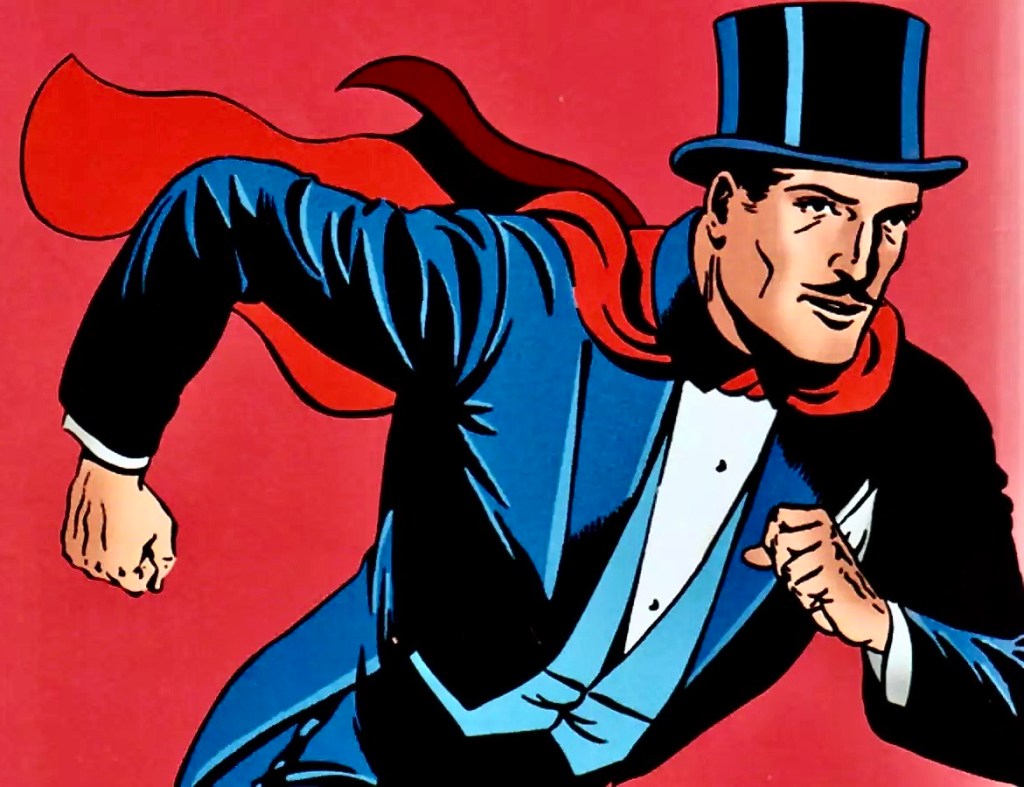
   Mandrake the Magician wasn’t as big as his sidekick Lothar but was bigger than he looked in comic books and newspapers. He looked like a man from another time. He wore a tuxedo, a cape, and a top hat. Oliver had met him once and wasn’t deceived by his get-up or unfashionable pencil lip mustache. 

   Donnie had never met him and was merry with disdain about the mustache. “What is that dead caterpillar doing on your face?” he said and laughed at his own joke. Nobody else laughed. Lothar glowered. Emma was appalled. Oliver was worried about what Mandrake might do. What the magician did was wave a hand and Donnie was instantly hypnotized.

   “Repeat after me,” Mandrake said. “I like Mandrake’s mustache.” The magic man snapped his fingers and Donnie came out of his trance.

   “I like your mustache, Mr. Mandrake,” he said.

   “Thank you, young man,” Mandrake said.

   Donnie reached for a Ho-Ho. He always had one within easy reach. He bit into the cylindrical morsel. It tasted better than ever.

   “Yum,” he murmured, his voice soft as a mourning dove.

   “Can you hypnotize Donnie about Ho-Ho’s, so he doesn’t eat them anymore, so he can lose some weight?” Oliver asked.

   “It’s the least I can do,” Mandrake said. He waved his hand again and Donnie again fell under his spell. The Ho-Ho in his hand fell limply to the ground. When he looked at it, it looked lonely on the ground/

   “From this moment, whenever you see a Ho-Ho, you will throw it to the ground and walk away. Do you understand?”

   “Yes, master,” Donnie said.

   Mandrake the Magician snapped his fingers and Donnie came to his senses, He reached into his pockets and began throwing Ho-Ho’s in all directions until he didn’t have anymore. He hung his head and let out a sigh.

   “About what we discussed on the phone,” Mandrake said to Oliver. “You say you suspect the Clay Camel and the Brass Monkey are in these environs committing thievery?”

   Oliver showed him the clay camel Donnie had found.

   “Once more the world’s cleverest thief and the world’s greatest master of disguise has left his clay camel at a crime scene,” Mandrake said. He handed the figurine to Lothar, who said something nobody but Mandrake understood. Lothar was one of the strongest men in the world but his English was horrible. Mandrake and he were best friends. One time, when an imposter claiming to be Lothar tried to take over his African homeland, Mandrake and Lothar went back to the Dark Continent to apprehend the imposters and restore order. They didn’t hold back. They got the job done. They were Number One when it came to getting it done.

   “What is this penguin going to do about my mom’s diamonds?” Donnie asked. The Ho-Ho sugar bombs were wearing off and he was feeling petulant. “He looks like he’s going to a fancy party.”

   “Mandrake stopped the Cobra from stealing the Crystal Cubes and taking over the world,” Oliver said. “He stopped Baron Kord from using his brain-washing chemicals to turn everybody into Kordies, mindless men and women whose only purpose would have been to follow orders. When his father Theron and the Magic School were attacked by invaders, he and Lothar came to the rescue and threw the invaders out of Tibet. He saved his girlfriend Princess Narda from the Mirror World. He went to the Netherworld and arrested the Mole. He stopped his twin brother Derek from using his powers for evil and when he tried again, he stripped Derek of his powers for good. If anybody can find your mom’s diamonds, it’s Mandrake.”

   ”I need a Ho-Ho,” Donnie complained in spite of himself.

   Mandrake had heard enough. He waved his hand and Donnie fell into a deep sleep. He waved his hand again and Donnie was teleported into his bed at home, where he spent the rest of the afternoon snoring, dreaming, and building chocolate castles in the air.

   “Where were we?” Mandrake asked.

   “The Clay Camel and the Brass Monkey,” Emma said helpfully.

   “Right you are, young lady,” Mandrake said. “Finding them isn’t going to be a problem. What is going to be a problem is getting our hands on them. The second we reach for him he will change his appearance and melt away. He is slippery as an eel. The Brass Monkey isn’t as slippery, but if she holds on to the Camel’s coattails, she will melt away just like him.”

   “How are you going to find him?”

   “I will find him with my Fortune Globe.”

   The Fortune Globe was the size of a billiard ball, clear and glossy. Lotar rubbed it vigorously and held it in the palms of his open hands. Mandrake the Magician leaned over his friend’s hands, studying it intently.

   “The Camel and the Monkey are hiding in the tower of the Kirtland Temple, which means they are ready to fall into our hands.” 

   “What do you mean?” Oliver asked.

   “From up in the tower, there is only one way for them to go, and that is down. On top of that, since the Temple closes soon, no matter what they disguise themselves as, there will only be the two of them. There isn’t anybody else there. We won’t have to pick them out of a crowd.” All the Mormons had gone to Utah long since.

   The church was 15 minutes away by car, but nobody in the crew knew how to drive. None of them had a car, anyway, even if they took driving lessons immediately. Mandrake had his own mode of travel. He and Lothar, Oliver and Emma, made a tight circle, holding hands. Mandrake softly spoke an incantation and the next second they were in the parking lot of the Kirtland Temple. 

   It was on a bluff overlooking the Chagrin Valley. It was built in the 1830s and dedicated in 1836 as a House of Prayer, Learning, and Order. It was the first Mormon Temple in the United States. The two-story church was white as white ever was, although it hadn’t always been. The Latter Day Saints had painted it blue gray back in the day. The roof had been red and the doors green. A thousand faithful gathered on the morning the doors opened, singing “The Spirit of God Like a Fire is Burning.” The preacher said a prayer, gave a speech, and was visited by Adam, Abraham, and several angels. Church leaders spoke in tongues in case anybody in the audience didn’t understand English.

   The lantern tower was on top of the roof, at the front of the church. There was a widow’s walk where the Camel and Brass Monkey were lurking, looking down on them. The Camel’s mouth was twisted with malice. The Brass Monkey’s mouth was red with lipstick. She sneered and flipped Mandrake the bird. The magician gave the bird the back of his hand and it flew away.

   “Watch the back door,” Mandrake told Oliver and Emma. The children took up their post. Mandrake spoke to his enemies, both father and daughter alike. “I am coming up to cut you down to size,” he said.

   “We have our rights,” the Camel shot back.

   “You have the right to remain silent,” Mandrake the Magician said, striding purposefully towards the front door, Lothar hard on his heels. Right and wrong was going to have it out.

Previously: Making Up Mandrake

Next: Mandrake and the Camel

Ed Staskus posts monthly on 147 Stanley Street http://www.147stanleystreet.com, Made in Cleveland http://www.clevelandohiodaybook.com, Atlantic Canada http://www.redroadpei.com, and Lithuanian Journal http://www.lithuanianjournal.com

A New Thriller by Ed Staskus

Cross Walk

“A once upon a crime whodunit.” Barron Cannon, Adventure Books

“Captures the vibe of mid-century NYC.” Sam Winchell, Beyond Fiction

Available on Amazon: https://www.amazon.com/dp/B0CRPSFPKP

Late summer and early autumn. New York City. A Hell’s Kitchen private eye. The 1956 World Series. President Eisenhower at the opening game. A killer in the dugout.

Making Up Mandrake

By Ed Staskus

   When Oliver’s friend Donald turned ten his parents threw a birthday party for him and hired a magician to entertain the kids. The magician wore a black tux, a black cape with a red lining, a black top hat, and carried an ebony stick that was a gadget cane. Everybody at the party was mesmerized by his tricks. He called himself Mandrake the Magician. 

   Some of Donald’s so-called friends called the birthday boy Dumbo. He was on the chunky side, teetering on the edge of fat. His friendlier friends called him Donnie and suggested he stop eating Ho-Ho’s, which were frosted cream-filled cakes. He had either just eaten one or was planning on eating another one. He had an effigy of Happy Ho-Ho, the mascot of the snack, in a special place in his bedroom. Happy looked like Robin Hood, fit and trim, including a feathered hat. Donnie thought if he ate just one more Ho-Ho he would presto chango look just like Happy. No matter how hard he tried, though, he looked more chunky every day.

   The day after the party Donnie’s mother asked if he had seen her diamond necklace. She said it was missing. Donnie didn’t even know his mother had a diamond, much less a necklace of them. She said she kept it under lock and key in an organizer case on a shelf at the back of her closet.

   “The necklace case is still there, but the necklace is gone,” she said. “I don’t understand it. The box is still locked but my diamonds are gone.”

   The Perry police couldn’t make heads or tails of it. The house didn’t appear to have been broken into. The box didn’t appear to have been broken into. The only fingerprints on the box were those of Donnie’s mother. There were no clues whatsoever. They were stumped. They wrote a report and went back to the station to wait and see if anything developed.

   Donnie went to see Oliver on Sunday. Oliver was the Unofficial Monster Hunter of Lake County. He dabbled in solving crimes, too. When Donnie got there he saw that Oliver’s dad was barbequing. He invited himself to the picnic table and stayed the rest of the afternoon. The children put their heads together after finishing their hot dogs and slaw.

   Emma had joined Donnie and Oliver when she smelled the pigs in a blanket ready for mustard. She was Oliver’s older sister and right-hand man. She claimed to be the brains of the operation, much to her brother’s displeasure. She had been at Donnie’s birthday party with him. She was puzzled by the theft. There weren’t many cat burglars stealing gemstones in their neck of the woods.

   “When did your mom last see the necklace?” Emma asked.

   “Mom said she cleaned it the day before my party.”

   “When did she notice it was missing?’

   “The day after the party.”

   “That means it was stolen the day of the party,” Emma said. “Did you see anybody sketchy at your house that day?”

   “No, just my friends,” Donnie said.

   “Nobody more fishy looking than them?”

   “The magician was sort of fishy looking,” Donnie said.

   “I think that might be it,” Oliver said. “I don’t think he was the real Mandrake the Magician, at all. Real magicians are the most honest people in the world. They tell you they are going to fool you, and then they do it. I think it must have been the Clay Camel. If it was, he is the man who stole your mom’s necklace.”

   “Who’s the Clay Camel?

   “He is Saki, who is a master thief and a master of disguise. He’s a bad seed and a bad dude, too. Money means everything to him. He can change his appearance in seconds. I’m sure he pretended to be Mandrake.”

   “Before we get into the weeds, who is Mandrake the Magician, anyway?” Emma asked.

   “He used to be a stage magician about a hundred years ago,” Oliver said. “Then he started battling crime and injustice. He fights gangsters, mad scientists, and creatures from outer space. His hat, cloak, and wand were passed down to him by his father. His father’s name is Theron. He runs the College of Magic in the Himalayas. The Mind Crystal, which he is the guardian of, keeps him and Mandrake going strong. Mandrake can shape shift, levitate, and teleport. He is the fastest hypnotist in the world. All he has to do is gesture and his enemies see illusions. He lives in Xanadu, a mansion on top of a mountain in northern New York, near Canada. He doesn’t need anybody’s diamonds, that’s for sure.”

   “What about this Clay Camel character” Emma asked.

   “He’s a member of 8, which is a crime organization a thousand years old. Whenever they commit a crime, they leave the number 8 behind as a marker so everybody knows they did it. Saki leaves his own mark, which is a little clay statue of a camel. Did you see anything like that.”

   “My mom showed me a clay camel after the party,” Donnie said. “She thought it was mine. I thought somebody forgot it when they left.”

   “Now we know it was Saki, for sure,” Oliver said. “He’s going to be a tough nut to crack, especially if he has his daughter with him, which he probably does, since she loves everything shiny and expensive.”

   “My golly, he has a daughter?” Emma exclaimed in surprise.

   “Her name is Brass Monkey. She has faster fingers than even her father.”

   “How are we going to find them and get my mom’s diamonds back?” Donnie asked.

   “Maybe the real Mandrake could help?” Emma wondered out loud. “Do you have his phone number?

   “I have it somewhere,” Oliver said. He ran upstairs to his bedroom. He didn’t have a filing system, or any organizational system, at all. He scribbled things on scraps of paper and stuffed them into drawers. It usually took days to find anything. It drove Emma crazy. He finally found Mandrake’s phone number and ran back downstairs.

   “Where have you been?” Emma asked, exasperated at how long it had taken. “Donnie has eaten a half-dozen Ho-Ho’s already.”

   Neither Emma nor Oliver had a cellphone. They weren’t allowed. Donnie had one, though. Oliver borrowed it and stepped to the side. He called Mandrake the Magician. After a few minutes he stepped back to the picnic table.

   “He said he would teleport himself here in a few minutes.”

   Five minutes late there was a whoosh and a sudden burst of smoke under the cell tower at the far end of their backyard. A man in a black tux and cape and another man with black skin stepped out of the smoke cloud.

   “I brought Lothar with me,” Mandrake the Magician said. “He’s always a big help.”

   Lothar was Mandrake’s best friend and crimefighting partner. He had once been the Prince of the Seven Nations, an African federation of jungle tribes. He was invulnerable to most weapons under the size of a cannon, unaffected by heat and cold, and had the stamina of a hundred men. He could lift an elephant with one hand. No spells, incantations, or force bolts could hurt him. He wore a purple fez, short pants, and a leopard skin. He didn’t say much. Besides, his English was horrible.

   “Thanks for coming, the both of you. We need all the help we can get,” Oliver said.

   “Let’s get to it,” Mandrake the Magician said.

Next: Mandrake on the Move

Ed Staskus posts monthly on 147 Stanley Street http://www.147stanleystreet.com, Made in Cleveland http://www.clevelandohiodaybook.com, Atlantic Canada http://www.redroadpei.com, and Lithuanian Journal http://www.lithuanianjournal.com

A New Thriller by Ed Staskus

Cross Walk

“A once upon a crime whodunit.” Barron Cannon, Adventure Books

“Captures the vibe of mid-century NYC.” Sam Winchell, Beyond Fiction

Available on Amazon: https://www.amazon.com/dp/B0CRPSFPKP

Late summer and early autumn. New York City. A Hell’s Kitchen private eye. The 1956 World Series. President Eisenhower at the opening game. A killer in the dugout.

Small Miracles

By Ed Staskus

   “What are you going to do with that?” Emma asked Oliver.

   “I’m going to shrink monsters with it from now on and take them away in my new paddy wagon,” Oliver said. “That way I won’t have to worry about what to do with them. Mom says Godzilla almost ate us out of house and home when he made all that trouble the last time and then slept over. When they are tiny I can feed them crumbs.”

   Emma looked at the toy police paddy wagon that was maybe big enough for a chipmunk. It was made of tin. It had red wheels and looked like it came from another century.  She burst out laughing.

   “What’s so funny?” Oliver asked.

   Oliver hunted monsters up and down Lake County. Emma was his older sister. They lived in Perry, Ohio with their parents. Both of them were taking piano lessons because their dad wanted them to. Both of them were well behaved most of the time because their mom said so. She had a severe strain to her that was not to be messed with. Both of them went to grade school Monday through Friday because the authorities of their town, the town of Perry, said so. Sometimes grown-ups were a bane to small fry.

   “You’re making some kind of ray gun that will shrink monsters? I don’t think so!”

   Since their mother wasn’t home at the moment, they got into a battle royal on the spot. They wrestled and fell off the sofa. They rolled back and forth on the carpet. Their cats, Sylvester and Son of Sylvester, wandered into the living room, took one look, and went the other way. They knew better than to get in the middle of a free-for-all between the two of them. The difference of opinion ended when they heard their mother pulling into the driveway. They were sitting quietly doing nothing when she walked in. She could tell she had interrupted something, but didn’t say anything other than, “Have you finished your homework?”

   Neither of them had even started. They trudged off to their bedrooms and put their noses to the grindstone. They were almost done by the time their mother called them downstairs for dinner. Their father was out of town on an inspection of an oil refinery in St. John’s, New Brunswick. He was an electrical engineer who specialized in oil refineries.

   “What are you going to do when cars don’t need gasoline anymore?” Oliver asked him one day.

   “I’ll cross that bridge when I get to it.” His father had a way of answering questions without answering them.

   “Are you going to go find that bridge in one of those Tesla’s like mean Mr. Efflux next door has got?”

   “He’s not a mean man, as long as you don’t unplug his car five minutes after he plugs it in.” 

   Mr. Efflux was a middleman. He prided himself on never being late to work. He wasn’t happy the morning his car ran out of juice four miles from home, stuck on the side of the road with no outlet in sight.

   Three days later it was early Saturday morning. Oliver’s father had gotten home late on Friday night and was sleeping in. Oliver’s mother was visiting their grandmother and helping her rake up the dregs of last fall’s leaves. Oliver was at the work table his father had set up for him in a corner of the garage. Emma walked in shaking the sandman out of her eyes.

   “What are you doing now?” she asked.

   “Wouldn’t you like to know, smarty pants!”

   When the spat was over, and they were catching their breath leaning on the work table, 

after they had put everything back where it belonged, Oliver showed Emma the ray gun he was working on.

   “That’s just one of your old squirt guns,” she said.

   “That’s what I want it to look like,” Oliver said.

   “How does it work?”

   “Oh, that’s easy, you just point it at whatever you want to shrink and pull the trigger.”

   “No, silly, how does it really work?”

   “Do you mean, how does it work or how does it really work?”

   Oliver and Emma went around in circles for a few minutes until they finally circled back to the red squirt gun that was going to be a ray gun soon. It didn’t look like much and Emma said so with a sniff. Oliver fiddled with it while Emma watched. He tightened a couple of screws, adjusted the sighting, and wiped off some spit that had landed on it during their scuffle.

   “Are you going to shrink all the monsters?”

   “No, only the ones who won’t listen to reason. The rest can go their own way.”

   “Whose reason?”

   “My reason.”

   “Where are you going to put the ones you shrink, after you have got them in your paddy wagon?”

   “I am going to build a small jail. I might build a small halfway house, too.”

   Oliver and Emma worked on the ray gun all morning. They thought they finally had it ready to go when noon rolled around. Their mother had come home and called them to lunch. The cats drifted out to the garage to see what they had been doing. Oliver and Emma shooed them away after they finished their seed butter cracker sandwiches and were back in the garage. They were ready to test the ray gun.

   “What are we going to shrink?” Emma asked.

   They looked around. There were no monsters anywhere. They walked up and down their neighborhood, as far as the Perry Cemetery, and down to the Grand River. It was a cool sunny day, crisp as a spring day could be. Tommy One Shoe joined them on their way home.

   “What are you working on?” he asked, stepping up to the work bench and eyeballing the red plastic squirt gun.

   “It’s a ray gun. It shrinks monsters down to size.”

   “I want dibs on it so I can cut my older sisters down to size,” Tommy said.

   “We have to test it first,” Oliver said.

   “Make sure you don’t point that thing at me.” Tommy didn’t want to be that day’s crash test dummy.

   “It might be better to test it on a thing rather than on a somebody,” Emma said. She was Oliver’s voice of good sense.

   “That’s probably a good idea,” Oliver admitted. “What can we test it on?”

   They stepped onto the apron of the driveway next door to their house. What they saw was Mr. Efflux’s Tesla in the driveway. The three children circled it. They agreed shrinking a neighbor’s house was out of the question. The neighbor might be inside it. The car seemed to be their best bet. Oliver unraveled an extension cord and plugged the ray gun in. He flipped the switch on, aimed, and pulled the trigger. There was a crackling hum like electricity on fire. The Tesla quivered and glowed and in a second shrank to the size of a matchbox car.

   “It works!” Oliver exclaimed. He ran and got his police paddy wagon. He slid the Tesla inside it. The little car fit perfectly. Oliver was beside himself. He and Tommy exchanged high fives.

   “We better get it back to what it was before Mr. Efflux sees what we’ve done,” Emma said.

   Oliver licked his lips. “I haven’t exactly thought that part through. I don’t know how to change it back, at least not yet.”

   “Oh, oh,” Tommy said and immediately went home.

   “What are we going to do?” Emma asked.

   Oliver rummaged around his tool box and found a 9 volt battery. He connected it to the little Tesla. Mr. Efflux wouldn’t be able to get inside the car, of course, but it would at least still run. Oliver put it back in Mr. Efflux’s driveway. A baby worm crawled underneath it to catch some shade.

   “Small miracles are better than nothing,” Oliver said as he and Emma ran back inside their house and locked the door before Mr. Efflux had to go somewhere in his car.

Ed Staskus posts monthly on 147 Stanley Street http://www.147stanleystreet.com, Made in Cleveland http://www.clevelandohiodaybook.com, Atlantic Canada http://www.redroadpei.com, and Lithuanian Journal http://www.lithuanianjournal.com

A New Thriller by Ed Staskus

Cross Walk

“A once upon a crime whodunit.” Barron Cannon, Adventure Books

“Captures the vibe of mid-century NYC.” Sam Winchell, Beyond Fiction

Available on Amazon: https://www.amazon.com/dp/B0CRPSFPKP

Late summer and early autumn. New York City. A Hell’s Kitchen private eye. The 1956 World Series. President Eisenhower at the opening game. A killer in the dugout.

The End of Jim Stubbs

By Ed Staskus

   “We have got to hurry,” Lucky Legs said. “Once the sun comes up out of the eastern ocean he will be impossible to see in the daylight.” The 19th century Boston man picked up the pace. Oliver stayed hard on his heels. It was 1871. They were after a spook. The phantom was rubbing everybody the wrong way and had to go.

   Oliver and Lucky Legs were after Jim Stubbs, a ghost who had been conjured up by one of Boston’s spirit photographers. After he sold the printed picture the photographer thought that was the end of Jim Stubbs. What he didn’t know was that Jim Stubbs liked being conjured up and had no plans of going anywhere. In the meantime, he was scaring the pants off Easties from Beacon Hill to Chinatown.

   When Oliver had gotten the photographer William Mumler’s SOS, he fired up his time machine. It was a long way from Perry, Ohio, and his time machine had long ago gone clanky as a bygone AMC Rambler, but he  always went where he was needed. Jim Stubbs drifted ahead of his pursuers through Boston Commons and down a side street. He was drifting almost faster than Oliver and Lucky Legs could run.

   They ran past a man who, even though he looked fit as a fiddle, looked like he could barely take another step. He was Al Spalding, a baseball player who was the starting pitcher for the Boston Red Stockings. He was their only pitcher. He started and finished all 31 games for the team that season, eventually winning 19 of them. The ball club was formed the year before by a Boston businessman who saw gold in the game. The team was made up of former players from the Cincinnati Red Stockings, who had gone out of business in their hometown. They brought the team’s name with them to Beantown.

   “That was a great game the other day,” Lucky Legs shouted over his shoulder. “You was hurling that pea.”

   “Thanks,” Al said. “I can’t wait for the season to end, though. It’s wearing me and my arm out.”

   Lucky Legs waved goodbye. Al tried to wave back but could barely raise his hand above his shoulder. He was in a bad way. He needed a rub-down in the worst way.. He needed a jigger even more.

   Oliver and Lucky Legs kept their eyes on the prize, which was easier said than done. Jim Stubbs could go through closed doors. He could go through walls. He could disappear through a ceiling. He made street cats and night watchmen jump out of their skins. Oliver had a sixth sense about ghosts and guessed right every time about where it was Jim Stubbs was going to twist and turn next.

   They stayed close, but not too close, not wanting to tip their hand.

   “What hand are we playing?” Lucky Legs asked.

   “What do you mean?”  

   “I mean, what are we going to do when we corral the rascal?”

   “To be honest, I don’t have a clue,” Oliver said.

   Lucky Legs didn’t like that but bit his tongue. So far the lad from the future seemed to know what he was doing. Maybe something would come to him before he went back to where he came from.

   When Jim Stubbs stopped to get his bearings, Oliver and Lucky Legs stopped. They crouched behind a bench. Oliver looked down at the seat where there was a stack of newspapers. It was the Woman’s Journal and Suffrage News.

   “What does suffrage mean?” Oliver asked. 

   “It means the women folk are fussing about getting the vote.”

   “How come?”

   “Because they can’t vote for nuthin’,” Lucky Legs said. “They don’t got sense.”

   “Where I come from, everybody can vote, men, women, and fools. My sister says wise men and fools both have gotten their names on the ballot. She says the president we had who just  got locked out of the White House, he was a Grand Dragon. She says he is Fool Number One.”

   Emma was Oliver’s older sister by two years. She told everybody she was the brains behind her brother’s monster hunting. Oliver scoffed at that, but knew it was true. She seemed to know everything he didn’t, and more besides. 

   “How can that be?” Lucky Legs asked. “Our president has just sent federal troops down to North Carolina to put a stop to Klan vigilantes taking the law into their own hands. U. S Grant is running the white hoods out of that state and out of the country.”

   “Our ex-president was a Klan man from his red cap on down.”

   Boston suffragist Lucy Stone founded the Women’s Journal and Suffrage News. The first issue had come out earlier that year. Oliver glanced at the front page, full of news and a poem. The verse was called “Looking Forward.” It was written by Lucy Larcom. “Beyond the boundaries of the grave send I a single fear, O spirits I have clung to here, will ye fulfill your dreams of immortality, my fear is, to be left of you alone.” Just then Lucy Larcom walked up and picked up the stack of newspapers on the bench.

   Oliver excused himself. “I was only looking,” he said.

   “Would you like to buy a copy?” Lucy asked.

   “How much is it?”

   “A penny,” Lucy said. 

   Oliver pulled a shiny dime out of his pants pocket. He handed it to Lucy, who made to make change, until she stopped herself. She turned the dime over several times. She was puzzled and said so.

   “This coin says it was minted in 2021,” she said. “How come you to have it?” 

   “I’m from the future, from the year 2023.”

   “Oh, I see,” Lucy said. “I need to turn a penny but I can’t take your coin. There are not many women who can do like I do with impunity, for I am above the little fears and weaknesses which are the inseparable companions of most of my sex, but taking a coin from the future is too much even for me.”

   Lucy’s hair had a careless if studied look. Tendrils fell around her face while curls and waves hung behind a large, loose topknot held in place with a comb. Her brown skirt was narrow and close fitting. An overskirt was draped to an apron front. A flounced underskirt and full petticoats threw out the bottom of the skirt.  As she made to go, Jim Stubbs drifted under the flare of her petticoat. Lucy jumped when she realized a ghost was breathing on her ankles.

   “What do you think you are doing?” she demanded of him.

   They were arguing his right to do as he pleased when Al Spalding came strolling their way. A thirty minute rub-down and a jigger had worked their magic. He felt like a new man. When he saw what Jim Stubbs was up to he pulled a baseball out of his back pocket. He spit chewing tobacco juice on it and rubbed it in. He threw the ball straight at Jim Stubbs.

   When the ghost ducked the sinkerball took a dive at the last second and beaned him in the head. The ball went through his noodle like it was a noodle. Jim Stubbs dropped like a shot. He fell into a pool of inky shadows. A train appeared out of nowhere and he was dragged into one of its coaches by a spectral arm. They watched the train go until it was gone.

   “Where did he go?” Lucky Legs asked.

   “I suspect  he went back to where he came from, which is nowhere,” the baseball player said. “My magic juice always gets the job done.”

   Oliver and Lucky Legs went to where Oliver had left his time machine behind a blacksmith’s shop. The monster hunter eyeballed the spot where he thought it might be. He had sprayed it with invisibility spray. He gathered up a handful of loose sawdust and tossed it into the air. When it fell like snow on the time machine it revealed its outline. Oliver had a Yale key in his pocket. He put it in the ignition. He fired the time machine up.

   “What shall I remember you by?” Lucky Legs shouted over the noise of the engine.

   Oliver flipped the shiny dime in his hand towards him. Lucky Legs plucked it out of the air like an Old World Flycatcher. Oliver’s time machine spun in fast furious circles until it wasn’t there anymore.

   “Yes, my boy, I shall certainly be in remembrance of you,” Lucky Legs said.

Previously: Searching for Jim Stubbs

Ed Staskus posts monthly on 147 Stanley Street http://www.147stanleystreet.com, Made in Cleveland http://www.clevelandohiodaybook.com, Atlantic Canada http://www.redroadpei.com, and Lithuanian Journal http://www.lithuanianjournal.com

A New Thriller by Ed Staskus

Cross Walk

“A once upon a crime whodunit.” Barron Cannon, Adventure Books

“Captures the vibe of mid-century NYC.” Sam Winchell, Beyond Fiction

Available on Amazon: https://www.amazon.com/dp/B0CRPSFPKP

Late summer and early autumn. New York City. A Hell’s Kitchen private eye. The 1956 World Series. President Eisenhower at the opening game. A killer in the dugout.

Searching for Jim Stubbs

By Ed Staskus

   Stepping out of the William Mumler Photography Studio in the heart of Boston, Oliver realized three things. Although he had a photograph of Jim Stubbs, it wasn’t much to go on. It was sketchy at best. The second thing he realized was that Boston was much bigger than his hometown of Perry, Ohio. It would be like looking for a needle in a haystack. The last thing was he was 150-some years away from home, in a strange land and time.

   He knew a century-and-a-half didn’t mean much in the world of monsters, but he was eight-and-a-half years old and it meant a lot to him. There wasn’t a volt of electricity in Boston. Everything was kerosene and steam power. The streets were illuminated at night by coal gas. When the moon was full the pole lights didn’t get lit. There were no cars. Everything was horses and wagons. There were piles of horse poop in the gutters. There were no TV’s. Everything was newsprint.

   Oliver didn’t often time travel but had answered William Mumler’s SOS about the great trouble Jim Stubbs was causing him. Oliver wished he had brought Emma, his sister and right-hand man, along with him but it was wishful thinking now. He would have to go it alone. He was brave enough, but even though he didn’t like admitting it, Emma was the brains of the operation.

   He looked around in all directions. Nothing looked familiar, which didn’t surprise him. He tried to think where to start. A young man approached him. “It looks like you be doing some hard thinking, lad,” he said.

   “I’m trying to find a ghost,” Oliver said. “My problem is I am from the future, from the year 2023, and I don’t know anything about 1871. I don’t know anything about Boston, either.”

   “Those are problems, indeed,” the young man said. “Maybe I can help. I know everything about Boston and everything about the city’s ghosts, although I have not heard about your spirit, your Jim Stubbs.”

   “If you can help me, that would be rad,” Oliver said. 

   “Rad?” the young man asked.

   “I mean good,” Oliver said.

   “What be your name?”

   “Oliver.”

   “I be called Lucky Legs.”

   “Can I call you Lucky for short?”

   “You can call me whatever you fancy,” Lucky said.

   When the Puritans first landed in Boston it was a rocky scrubland. There were hardly any trees but there were three hills. The Puritans believed their new place was a “City Upon a Hill.” Anybody who disagreed was either whipped or banished, or both. Catholicism was forbidden. Mary Dyer was hanged in Boston Common for defying a law banning Quakers. The biggest earthquake to ever hit the Northeastern United States struck the city in 1755. Five years later a “Great Fire” burned one neighborhood after another down to the ground.

   Boston’s population was more than a quarter million hoi polloi and their betters. The financial elite were the Boston Brahmins. “Here’s to good old Boston, the land of the bean and the cod, where Lowells talk only to Cabots, and Cabots talk only to God,” is how everybody understood it. William Gaston was the mayor the day Oliver landed there. The city was the religious, political, and commercial capital of New England. Before the Civil War, which ended a few years earlier, it was the launching pad for the north’s anti-slavery activities. When the Irish flooded the city after 1840 the Yankees made them do the dirty work. Irish women did cleaning work, cleaning up after the Lowells and Cabots.

   “Where should we start?” Oliver asked.

   “There be only one place to start and that be the Central Burying Ground,” Lucky said. “Follow me, sonny boy.”

   The Central Burying Ground was in a corner of Boston Commons. The city’s poorest folk were buried there in mass graves. Most of them were dismayed at being buried in a pit. The Dell, a large tomb, housed the remains of graves disturbed by street construction. “Many who stop there at night to catch their breath report feeling like somebody is standing next to them. They witness flashes of light, floating orbs, and more frightful occurrences,” Lucky said. “It will be twilight by the time we get there so we are going at a good time.”

   They passed the Omni Parker House, which was a hotel. “Charles Dickens used to stay there,” Lucky said. “He even lived there for two years. It was where he first performed ‘A Christmas Carol’ during one of their Saturday Clubs. He died just last year, back home in England. Now the rumor is his shade haunts the third floor, which was the floor he always stayed on. Some polite folk won’t sleep on that floor for fear of the Devil.”

   “How do you know so much about ghosts?” Oliver asked.

   “Because I am the under the table son of the Lady in Black,” Lucky answered.

   “Under the table?”

   “Never mind about that. See that island?” Lucky asked pointing to Georges Island at the entrance to Boston Harbor. “That be Fort Warren squatting on the land there. It opened for business just in time for the Civil War and just in time to kill my mother.”

   Fort Warren was built to protect Boston from Johnny Reb. The marching song ‘John Brown’s Body’ was written at the fort. The music was lifted from an old Methodist camp song. A half-moon battery of cannons protected the north sally port. The 15-inch smoothbore guns never fired a shot during the war. Instead, the fort became a prison for captured Confederates.

   “My mother came to Boston with me in tow in 1862,” Lucky said. “Her husband, not my father, was imprisoned at the fort. She cut her hair to make herself look like a man and snuck onto the island. She had a pistol and a pick axe. She was small enough to squeeze through the bars of the window of his cell. They tunneled out of the cell and were almost away when a guard overtook them. He slapped the pistol out of my mother’s hand. When it fell it discharged. The bullet hit her soul mate and ended his poor life on the spot. She was captured, tried, and sentenced to hang. She begged for a white dress to wear at the hanging, but they fitted her out with a black robe, instead. Many there are who see her wandering the island, unhappy and wailing, still in the same black robe.”

   They passed Faneuil Hall. “That place be haunted every which way,” Lucky said. “It was a place where slave traders used to sell darkies from Madagascar. Peter Faneuil made his fortune there at what we now call ‘The Cradle of Liberty.’ You see that golden grasshopper weathervane on top of the hall? There is a slave girl ghost who swings from it some nights, laughing at us passing by, laughing because she is now free.”

   They walked through the Quincy Market, an open air market added on to Faneuil Hall fifty years earlier. It was getting dark. Everybody was going home. When Oliver and Lucky got to the Central Burying Ground there wasn’t a mortal man in sight. A scruffy dog barked at them. Lucky patted him on the head, slipped him a shaving of goose jerky, and the dog joined them.

   Before long the sky got inky, but when a full moon rose Oliver and Lucky could see well enough. They settled down on the ground, leaning back against headstones. Nothing happened. Midnight came and went. Lucky fell asleep. The dog fell asleep, his head in Oliver’s lap. The middle of the night came and went. All of Boston, except for the city’s night watchmen, was asleep.

   It was not yet dawn when their mongrel companion started barking up a storm. Oliver and Lucky jumped to their feet. Oliver rubbed the sleep out of his eyes. He looked in the direction the dog was barking. 

  “Hey, that’s him, that’s my ghost,” Oliver exclaimed pointing to Jim Stubbs in the distance. He was more shadow than man. “Let’s go!” 

   “Hey ho,” Lucky whooped, hard on Oliver’s heels.

Previously: Resurrecting Jim Stubbs.

Next: The End of Jim Stubbs.

Ed Staskus posts monthly on 147 Stanley Street http://www.147stanleystreet.com, Made in Cleveland http://www.clevelandohiodaybook.com, Atlantic Canada http://www.redroadpei.com, and Lithuanian Journal http://www.lithuanianjournal.com

A New Thriller by Ed Staskus

Cross Walk

“A once upon a crime whodunit.” Barron Cannon, Adventure Books

“Captures the vibe of mid-century NYC.” Sam Winchell, Beyond Fiction

Available on Amazon: https://www.amazon.com/dp/B0CRPSFPKP

Late summer and early autumn. New York City. A Hell’s Kitchen private eye. The 1956 World Series. President Eisenhower at the opening game. A killer in the dugout.

Resurrecting Jim Stubbs

By Ed Staskus

   Oliver didn’t like time traveling. He didn’t mind the travel part but didn’t like the time part. It took forever to push the time machine out of the garage, pull off and fold up the heavy waterproof cover, lube the gearbox, check the oil, and gas it up. It was bad on gas on top of everything else. He had to push hundreds of buttons and levers and switches to get it ready to blast off. Then there was the count down. Unlike NASA space ships, which took off after a ten count, the time machine required a one thousand count, counting backwards.

   God forbid he lose count, which happened once, and he had to go all the way back to the beginning. When he did he forgot when and where he was going, fumbled around with his memory, and finally gave up the project when his bedtime drew near. Since then he hadn’t gone time traveling. But the Jim Stubbs mash-up was too big to ignore. It was time to suit up again.

   The time machine was both simple and complex. When it was time to go Oliver fastened his seat belt, dialed up the target date, sometime in the past or the future, and pushed a big red button that said “GO.” He watched and waited while time rewound or fast forwarded. It never took long to get to the target time and place unless it was many centuries away. When he got there he sprayed the time machine with invisibility spray and marked the coordinates with a sextant. The worst thing that could happen would be to not be able to find it again.

   It would have been easier to use a cell phone with GPS, but his mother wouldn’t let him or his sister Emma, who was his right-hand man, have one even though he was already eight years old and his sister was ten years old. Their mother was conservative and believed in family values. All the things the family had, like their cars and computers, were new as could be. The woman of the house, however, stayed in her believe-you-me ways when it came to beliefs.

   “Mom,” Emma asked, “why do we have to take old stuff for granted?”

   “First of all, it’s not old stuff, and second, you’re too young to understand.”

   “I will never be old enough to understand,” Emma groused.

   Her mother ordered Emma to go to her room. She pulled out her cell phone. It was almost as big as an iPad. “You go to your room for an hour, young lady,” she said. “I’m timing it.”

   In her room Emma flopped on her back on her bed. She raised an arm and pointed at a corner. “And in this corner, still undefeated, my mom and her long-held beliefs,” she said but not so loud that her mother could hear her.

   Oliver and Emma were the Monster Hunters of Lake County. They lived in Perry, about 30 miles east of Cleveland, Ohio along the south shore of Lake Erie. He was the best monster hunter in the county, if not the whole state, even though he was the youngest. He had a sixth sense about it. Most of the others didn’t have any sense about them. Most of them were booski’s who were forever getting lost in the weeds.

   He landed his time machine in Boston near William Mumler’s Photography Studio. The spirit photographer was a big hit in his part of the world, especially since he had been arrested for fraud in New York City a year before. He took pictures of people, photographs that included, when they were developed, images of their deceased loved ones. Not everybody believed in the pictures. P. T Barnum, circus man and self-appointed expert on suckers, testified at the trial that it was all hokum. 

   “It’s all a sham,” he said. But the jury couldn’t make up its mind. It became a mistrial. William Mumler went back to Bean Town a free man.

   William Mumler charged a dollar for a portrait. He charged ten dollars for a portrait when it included a spirit. When Emma did the math later ten dollars came out to more than two hundred dollars in today’s money. When she asked her mother if capitalism was a family value, she had to spend another hour in her room and pay her mother a dollar for bothering her.

   “We believe in family values in this family, do you understand me, young lady?”

   “Yes, mom,” Emma said and crept away.

   William Mumler displayed a photograph of Mary Todd Lincoln. He took it in 1870. It astonished everybody. A translucent image of Abraham Lincoln, her husband, was in the picture sitting beside her on the sofa. The picture was taken five years after Abraham Lincoln had been assassinated. “He looks so alive,” everybody said. Nobody thought it was a trick. Only the photographer knew it was a trick. He didn’t tell anybody, least of all himself.

   “You can fool some of the people all of the time, and all of the people some of the time, but you cannot fool all of the people all of the time,” Honest Abe had once said. He spent most of his days when the 21st century rolled around rolling over in his grave. Years of day-to-day lies on Fox News, Twitter, and Facebook had worn him out. “If I ever come back I am coming back as Dishonest Abe and fight fire with fire, especially with that Donald the Borgia.”

   The spirit photographer had sent an SOS about Jim Stubbs by telegraph to every ghostbuster he knew or had ever heard about. Oliver wasn’t exactly a ghostbuster and was living a century and a half later, but he somehow got wind of the SOS. He didn’t know how to reply since telegraphs were long gone but he wanted to help, even though the time machine was a pain in the butt. Landing it in the Back Bay had been a struggle. It was 1871 when Oliver appeared out of the blue in Boston.

   “The Jim Stubbs photograph I made is a phony, but Jim Stubbs, even though he is no longer real, has become real again,” William Mumler’s telegraph read. “He has come back and won’t leave. He is scaring the life out of everybody. Please come and help.”

   Oliver walked into the photographer’s lobby like a duck out of water. A police officer on the beat looked him over. The boy looked queer to him. The police officer was an older man and  carried a standard issue six-foot pole painted blue and white. It was what he used to protect himself. He had a rattle to call for help in case things got out of hand. Boston was bustling with the high and low. Landfills and annexations of neighboring villages had grown the city from one square mile to forty square miles. Shoe and textile factories were around every corner. Maritime commerce out of the ports sailed worldwide. Everybody was taking in boarders in the North End and on Fort Hill as immigrants poured into the city.

   William Mumler had gotten many offers of help, but none from a boy who walked, talked, and dressed like he was from a different world. “Who are you,” he asked, scratching his beard. He would have scratched his head except he was nearly bald.

   “My name is Oliver,” Oliver said. “I’m a monster hunter, although I go after spirits and creatures, too.”

   “What do you do when you find them?”

   “I tell them to go away.”

  “What if they refuse to go.”

   “I have my own way of getting results.”

   “You’re not from Boston, are you?”

   “No.”

   “Do you mind if I take your picture?”

   “No, I don’t mind.”

   The first photographic portrait studio ever in the United States opened in Boston. Oliver sat for his picture. He had to sit still for five minutes for the taking of it, which was on a glass plate. The photographer took it into a back room to develop. When he came back he was scratching his beard again.

   “I don’t know what happened, but everything is in the picture except you.”

   He tried again. When he came back again he showed Oliver the second photograph. The background was in the picture. The chair Oliver had sat in was there. What wasn’t there was Oliver.

   “Are you a spirit of some kind?”

   “No, but I came here in a time machine from 2023. Maybe that’s why the camera can’t see me.”

   “The year 2023 in the future?”

   “Yes.”

   Oliver could tell the spirit photographer had a million questions. He wasn’t ready and willing to answer a million questions. “What is your Jim Stubbs problem, exactly?” he asked.

   “My problem, young man from the future, is that I resurrected Jim Stubbs, and now the villain won’t go back to where he belongs.”

Next: Searching for Jim Stubbs.

Ed Staskus posts monthly on 147 Stanley Street http://www.147stanleystreet.com, Made in Cleveland http://www.clevelandohiodaybook.com, Atlantic Canada http://www.redroadpei.com, and Lithuanian Journal http://www.lithuanianjournal.com

A New Thriller by Ed Staskus

Cross Walk

“A once upon a crime whodunit.” Barron Cannon, Adventure Books

“Captures the vibe of mid-century NYC.” Sam Winchell, Beyond Fiction

Available on Amazon: https://www.amazon.com/dp/B0CRPSFPKP

Late summer and early autumn. New York City. A Hell’s Kitchen private eye. The 1956 World Series. President Eisenhower at the opening game. A killer in the dugout.

Rockets’ Red Glare

By Ed Staskus

   “Don’t you get scared fighting all those monsters?” Tommy One Shoe asked Oliver, who was chewing on a blade of grass. It tasted like somebody’s bare foot. He spit it out.

   Whenever there was monster trouble, and somebody asked who they should call for help, Oliver was at the top of the Help Wanted list. Tommy was one of his best friends. Emma and Dorothy were with them. Emma was Oliver’s older sister and right-hand man. Dorothy was Tommy’s next-door best friend. They all went to the same school, Perry Elementary, except they didn’t go to school in the summertime.

   It was the morning of the Fourth of July. The day had been a federal holiday since 1941, but the tradition of Independence Day went back to the 18th century and the American Revolution. The Continental Congress voted for independence 246 years ago and two days later rolled out the red carpet for the Declaration of Independence. Since then, there had been parades, concerts, and fireworks galore to celebrate the big day. 

   Oliver mulled over Tommy’s question. “If I thought about it too much you bet I would be scared,” he said. “I leave the thinking to Emma. Most of the time there’s too much going on to be scared, anyway. The best thing to do is go into action. If you stand around too long your worst fears can come true any second.”

   “I’m more scared of shots than I am of Dracula,” Tommy said. “I’m even more scared in the doctor’s office. They make you wait forever for the shot.”

   They were at Indian Point Park, just minutes from where they lived. Oliver and Emma lived in the Canterbury Crossing Condominiums while Tommy and Dorothy lived in the Pebble Creek Crossing Condominiums, They had walked to the park. It was a warm sunny day. They were where the Grand River and Paine Creek bumped into each other. There was a totem stone nearby. The names of boys who went to Charles Lyman’s military camp there a hundred years earlier were carved into the stone. The encampment back then was called Camp Wissolohichan. Nobody knew how to pronounce it.

   “I love your name,” Emma said to Dorothy.

   “I hate it,” Dorothy said. “My mom saw some old movie about a little girl who fought witches and flying monkeys. The girls name was Dorothy. My mom said she was the bravest girl in the world and so she named me after her.”

   “Do you have a nickname,” Emma asked. “I could call you that.”

   “No, but you can call me Dottie, which is what everybody else calls me.”

   “I have an uncle who changed his name when he was nine years old.”

   “I never heard of anybody nine years old being allowed to do that,” Dottie said.

   “He did and he made it stick,” Emma said. “His name was Harold. Everybody called him Hal. One day he told everybody they had to start calling him by his new name if they wanted to stay friends with him.When they asked he told them he had changed his name to Magnus. After that everybody called him Mags. He didn’t like it when he found out Mags was a girl’s name. He changed it again to William. Everybody called him Billy after that.”

   “My mom would kill me if I tried to change my name,” Dottie said. Emma nodded solemnly in agreement. She knew full well how serious adults could be, especially her mother.

   “What if a monster tried to kill you?” Tommy asked Oliver.

   “I would tell them it’s not allowed,” Oliver said. “They can try to run away, but no killing.”

   “What if they don’t listen?”

   “I have my ways of making them listen. If they don’t, I destroy them. If I have to, I destroy them twice. After I do that they never come back.”

   “What are you doing later on?” Tommy asked.

   “We’re having a barbeque,” Oliver said. Americans eat almost two hundred million hot dogs every Fourth of July. “My dad is doing burgers and dogs.” Their mother didn’t cook anything unless it was a pasta salad. “You and Dottie are both coming over, don’t you remember?”

   “Oh yeah, sure,” Tommy said, racking his memory. He was called One Shoe because he forgot his second shoe one morning on the way to school and spent the rest of the day limping around in the other shoe, dragging his bare sock behind him, wearing a hole out in it.

   “Did you know that some of the soldiers who were in the Revolutionary War didn’t have shoes, not even one shoe, and they wore rags for socks?” Oliver asked Tommy.

   “What do you mean? How could that be?” It still got on Tommy’s nerves whenever anybody even hinted at his one shoe false step. “How do you know that?”

   “Our teacher told us all about it, about how some of the soldiers froze at Valley Forge and how their toes fell off.”

   “My dad says we are free because of Valley Forge,” Tommy said. “He calls it the War of Independence. He was in Afghanistan when he was in the army before I was born. He says it was awful, but it was something that had to be done.”

   “Does he say why?”

   “No, he never talks about why. I asked him if he was scared. He said yes, but the other side of fear is freedom, which is the side we want to be on, whatever that means.”

   Oliver and Tommy thought about what it might mean but gave up. They eye-balled a river otter swimming past them. The spring thaw had resulted in flooding but there hadn’t been any heavy rain since mid-May. The water was like a quiet country road. The otter took its time. They took their time watching it.

   “We otter get going,” Oliver joked.

   “Are your relatives going to be at the barbeque?” Tommy asked as they walked up a trail to the bluffs overlooking the Grand River.

   “Yeah,” Oliver said.

   “Oh, man, does that mean we have to do crafts?” Tommy asked. Oliver’s relatives always brought scissors and glue. Everybody who was a child had to join in. He wasn’t an arts and crafts boy. He liked to eat, though.

   Oliver and Emma’s relatives coming to their Fourth of July barbeque were from their mother’s side. They lived nearby. There were two sisters and their husbands. One of the husbands drove a Jeep and repaired car washes. The other man drove a RAM pick-up and was the silent type. He usually had his face in his cellphone. Both men were conservative family men. There were four grown-up children, all girls, all in their early 20s. All of the young women had a lazy Susan of boyfriends.

   After they watched house flies getting dizzy at the sight of the barbeque buffet, then eating their fill when their turn came, and later throwing a Frisbee back and forth for an hour, afterwards taking a quick nap, when the long day finally settled into dusk Oliver, Emma, Tommy, and Dottie walked to the Madison Avenue Estates. Their friend Jimmy lived there and had a box of bottle rockets ready to go.

   “It’s like an exploding Christmas,” Dottie said, watching the rockets’ red glare in the night sky.

    “Independence Day is the best day ever,” Emma said.

     “You bet it is,” Tommy One Shoe said. “Today is the day Will Smith saved us from the aliens.”

Ed Staskus posts monthly on 147 Stanley Street http://www.147stanleystreet.com, Made in Cleveland http://www.clevelandohiodaybook.com, Atlantic Canada http://www.redroadpei.com, and Lithuanian Journal http://www.lithuanianjournal.com

A New Thriller by Ed Staskus

Cross Walk

“A once upon a crime whodunit.” Barron Cannon, Adventure Books

“Captures the vibe of mid-century NYC.” Sam Winchell, Beyond Fiction

Available on Amazon: https://www.amazon.com/dp/B0CRPSFPKP

Late summer and early autumn. New York City. A Hell’s Kitchen private eye. The 1956 World Series. President Eisenhower at the opening game. A killer in the dugout.