
By Ed Staskus
“Well, well,” the Grim Reaper said. “What have we got here, Hansel and Gretel?” He grinned looking down on them and then laughed like a hen with hiccups.
“Oh, oh,” Emma said, looking him up and down. She didn’t like what she was seeing or hearing. Who laughs like a hen with hiccups?
“No, we’re not Hansel and Gretel,” Oliver said. “Who do you think you are? It’s not Halloween. And what’s with the laugh?”
“Who do I think I am? I am the Prince of Darkness, Lord of the Flies, and Old Nick all wrapped up in one. I am Scratch and that’s no Halloween nonsense. I am the Grim Reaper.”
“All right, Mr. Grim, but what’s with the laugh?”
“I’ve got something in my craw I just can’t shake.”
“Would that be the Angel of Life?”
“Never you mind, young man.”
“Why are you calling us Hansel and Gretel? Do you think you are going to eat us?”
“I ask the questions around here,” the Grim Reaper said. “What are you doing in this castle?”
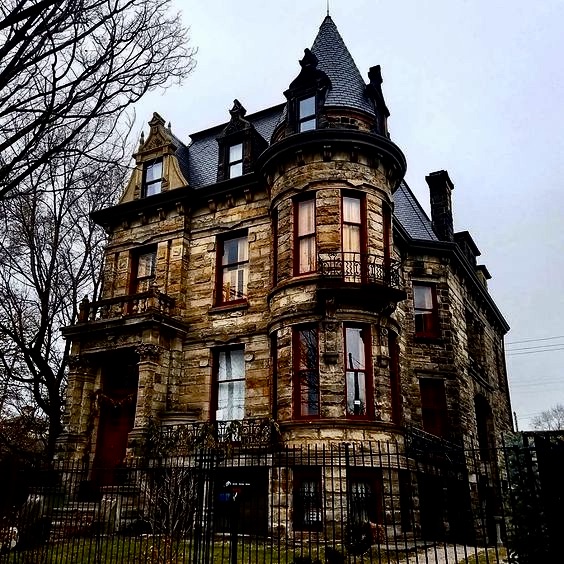
“We have a professional interest in Franklin Castle,” Oliver said. “We’re the Monster Hunters of Lake County.”
“Have you lost your way? This is Cuyahoga County. On top of that, you’re nothing but children. What kind of professional interest could you possibly have in anything? Are you half-pints even in school?”
“I just started middle school, I’ll have you know,” Emma said.
She had seen the Grim Reaper in a history book, a long-haired skeletal figure from the 14th century wearing wings and carrying a scythe. His black clothing went back to the early 19th century, when people started wearing black at funerals. The full Monty, hooded skeleton, black robe, and scythe, became common around the mid-19th century. That’s what he looked like in “A Christmas Carol” by Charles Dickens, wearing a dark cloak with only a single gesturing hand to be seen.
“People fear me, you know,” the Grim Reaper said.
“I once heard a song called ’Don’t Fear the Reaper,’” Oliver said.
“All our times have come here, but now they’re gone, seasons don’t fear the reaper,
nor do the wind, the sun, or the rain.”
“That was some tough talk by the Blue Oyster Cult,” the Grim Reaper said. “Do you know what their new album last year was called?”
“No.”
“It was called ‘Ghost Stories.’ That’s what they’re going to be sooner or later. I saw one of their shows. After the show I made a joke, asking them, ‘What did the chicken say to the Grim Reaper?’ The drummer was like you. He asked me why I was asking. I told him because I was death myself.”
“What did he say?”
“He said, ‘I’ll talk louder then.’ He was half deaf from his own loud music and misunderstood what I said.”
“What did the chicken say, anyway?”
“I should have looked both ways,” the Grim Reaper chuckled.
“What’s with that stick with the curved knife at the bottom?” Oliver asked.
“It’s not a stick and it’s not a knife. It’s a scythe. It’s for harvesting souls like a farmer harvests crops.”
“Farmers use tractors, not that scythe thing.”
“The scythe is what farmers used to work their fields with.”
“Well, they don’t use them anymore. You should get a tractor.”
“That’s not the point,” the Grim reaper said, annoyed. “It’s a symbol.”
“Symbols don’t put food on the table,” Emma said. “Dad has to go to work every day and mom just got a job so we will have money for college. We are buying a new house soon, too. Does the FBI know you carry that scythe thing around? It looks like a deadly weapon. Is it legal?”
The Grim Reaper was not used to being peppered with questions. “Why me, why now?” is what he sometimes heard, although most people were scared stiff and didn’t say much of anything. Whenever they asked he always said, “Life is for the living but then I arrive with my scythe and you are done with life. Then they throw dirt in your face. Then the worms eat you. Be glad it happens in that order.”
“Did you hear what I asked you, Mr. Grim?” Emma asked. “Is that thing legal?”
The Grim Reaper was losing his patience. He was normally very patient. Life spans, however, had been increasing century by century and appointed hours had become long in coming. The trend was taxing him. These children questioning his tools of the trade were irksome. Their appointed hour wasn’t close at hand, but if they kept it up he might lose his composure and go after them.
“You should put that thing away and get some nicer clothes,” Emma said. “That robe has got moth holes. It’s really dirty, too. Do you ever wash it?”
That was all the Grim Reaper could stand. He raised his scythe and swung at Emma. She jumped away from the swing. She was a quick girl on her feet.
“Hey, what do you think you’re doing?” Oliver shouted. “Leave my sister alone.”
The Grim Reaper swung his scythe at Oliver, who dodged the sharp blade, grabbed Emma’s hand, and pulled her towards the door. The Grim Reaper weas fuming. He never swung and missed. Was he getting old and feeble? That couldn’t be. He was ageless, after all.
“This house has thirteen fireplaces,” he shouted. “ When I catch you I will burn you both in all of them.”
He ran after Oliver and Emma, his bones clacking and the scythe hissing. He wasn’t fast enough. Oliver and Emma pushed the ballroom doors open and ran down the stairs. The Grim Reaper followed, making up time by straddling the handrail and sliding down it.
Oliver and Emma ran past the reading room on the third floor where a book was reading itself. It was a one thousand page weepie. Tears were splashing onto the pages. They ran past Hannes Tiedemann’s office on the second floor. The ledgers in the office had long since turned to yellow dust.
By the time they got to the ground floor the Grim Reaper was hard on their heels. A voice called out to them, “Come this way.” It was the ghost of Hannes Tiedemann. “Get in this barrel,” he said, pointing to a barrel. They got in it. Hannes Tiedemann fitted a circular lid on top of the barrel.
After coming from Germany as a boy Hannes Tiedemann had worked as an apprentice barrel maker before getting into wholesale groceries and later into banking. He liked money well enough, but never lost his fondness for barrels.
The Grim Reaper searched the ground floor, the foyer, parlor, and dining room. He searched the toilet room. He came up empty. Gnashing his teeth he went up and came back down the servant’s stairwell. He was standing in the foyer when he noticed his reflection in a full-length mirror. Looking himself over he thought maybe the brat was right. He was looking shabby. He needed a new robe. He checked his wallet. He had enough cash to get something nice. He went out the front door and disappeared down Franklin Ave. towards the stores on W. 25th St.
When Oliver and Emma were sure he was gone they got out of the barrel and ran outside to where they had left their Lime e-scooter. It wouldn’t start, however. It had timed out. Neither of them had a credit card. Neither of them had ever had a credit card. They pushed the e-scooter off the sidewalk and leaned it against the wrought-iron fence surrounding the house.
It was a long walk back to St. Ignatius High School. They were very tired by the time they got there. Their father put them in the back seat of their Jeep SUV. He drove north to Lake Erie and took a right. He took the Shoreway back to Lake County. Oliver and Emma slept like the dead all the way home.
Previous: Franklin Castle Walkabout
Ed Staskus posts monthly on 147 Stanley Street http://www.147stanleystreet.com, Made in Cleveland http://www.clevelandohiodaybook.com, Down East http://www.redroadpei.com, and Lithuanian Journal http://www.lithuanianjournal.com. To get the site’s monthly feature in your in-box click on “Follow.”
“Made in Cleveland” by Ed Staskus
Coming of age in the Midwest in the 1960s and 1970s.
“A collection of street level short stories blended with the historical, set in Cleveland, Ohio. The storytelling is plugged in.” Sam Winchell, Beyond Books
Available on Amazon:
A Crying of Lot 49 Publication

 Monster Hunters of Lake County