Tag Archives: Monster Story

Front Lawn of Fear

By Ed Staskus

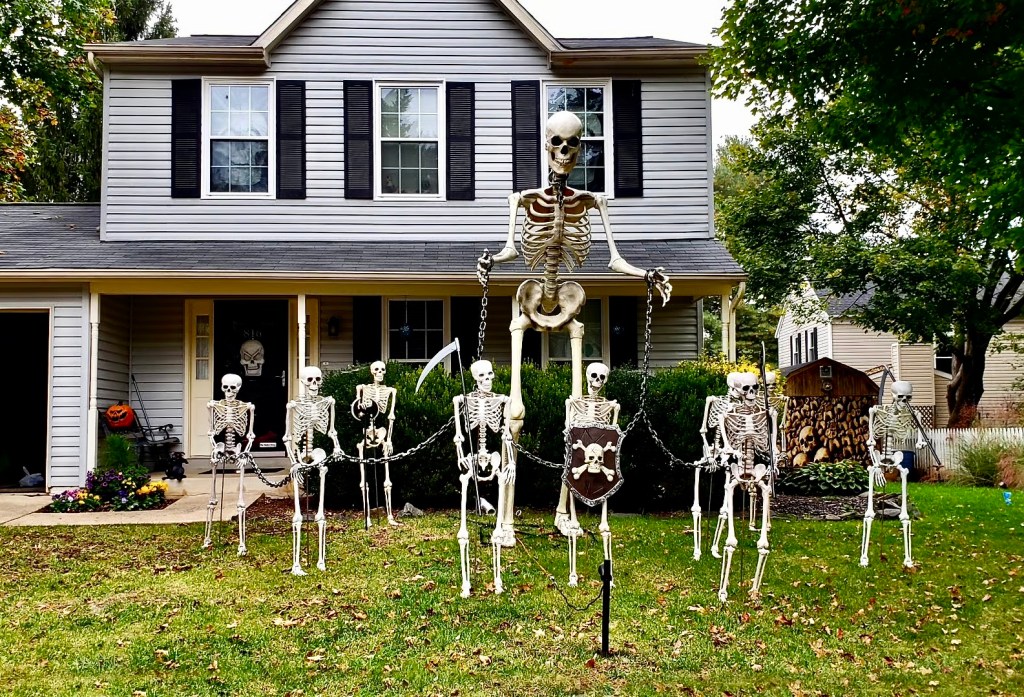
   Oliver had heard about the house with the front lawn full of life-size skeletons, but had never seen the Halloween display himself. It was down Canyon Ridge Dr. on the east side of the street. The street was about a ten minute walk from where he lived. “There‘s a bunch of skeletons carrying some kind of hatchet and one really big one who’s the leader of the pack,” Tommy One Shoe said. “They’re all chained together, but they’ve been getting loose in the middle of the night the closer it gets to fright night.”

   “If they’re carrying something, it’s probably a scythe,” Oliver said.

   “What’s that?”

   “A farming thing from long ago.”

   “Oh.”

   Oliver knew which house it was, at least he knew the backyard of it. He had seen it many times looking up from Masons Landing Metropolitan Park on the Grand River where there was a bend and a stretch of bank. He could see it from the bank. It was the only house on the street with a side yard. It was the only house with a sweet gum tree. The fruit of the tree was a hard spiky ball he called a monkey ball. Nobody wanted to step barefooted on a monkey ball. He knew that from personal experience.

   “What do you mean they’ve been getting loose?” Oliver asked.

   “They get loose from their chains somehow and roam around at night waking everybody up. Their bones rub against each other clicking, clacking, and rattling.”

   “I guess that might be a nuisance,” Oliver said, “but it doesn’t sound menacing.”

   “That’s not all they do.”

   “What else do they do?” 

   “They swing their scythe things at shrubs, the mailboxes, and cats on the loose. All the shrubs look terrible, like a really bad haircut.  A bunch of mailboxes have holes in them. One cat ran up a tree and wouldn’t come down for two days.”

   “That sort of sounds like teenagers on the loose.”

   “Maybe it does, but last night a lady was walking her dog. It was late. She was looking one way, the skeleton was looking the other way, and they bumped into each other. She ran home and the dog chased the skeleton to South Ridge Rd.”

   “The skeleton ran away?”

   “That’s what she said, and she said the dog came back with a scrap of black fabric stuck in his teeth.”

   “I see,” Oliver said. “Can you sneak out tonight and meet me across the street from the skeletons?”

   “What time?” 

   “Let’s say three. My parents don’t get up at three in the morning for anything.”

    “No problemo,” Tommy said. “Mine don’t get up for anything between midnight and sunrise, unless maybe the end of the world was happening.”

   That night at three in the morning Oliver and Tommy met across the street from the front lawn of fear. Both of them were wearing jeans and dark sweatshirts. Oliver had a flashlight with him. He would have brought his sister Emma for back-up, but she was at a sleepover in Painesville. Tommy had a plastic Ninja Sword he had gotten from the Spirit Halloween store in Mentor. He whacked the bark of the pin oak tree they were hiding behind.

   “You’re going to break it,” Oliver said.

   “No, that’s some tough bark.”

   “I meant the sword, and besides, we need to be quiet.”

   “What’s the plan?”

   “The plan is to throw some light on whoever it is in that house who is pretending to be a skeleton, and why.”

   They almost fell asleep. It was nearly five in the morning when they were roused by a car coming down the street. Oliver had been wool-gathering the new ray gun he was inventing. The car pulled into the driveway of the house where they were hiding. They squeezed close together behind the pin oak tree. A man in a uniform got out of the car. He had a rolling carry-on suitcase and a flight bag full of manuals, a headset, and an iPad. He was a Southwest Airlines pilot.

   He was fumbling in his pocket for his house keys when Tommy saw a skeleton wielding a scythe crossing the street. He was heading straight for the pilot, one determined step after another. A full moon illumined him. It wasn’t a real skeleton. It was man dressed in black tights and a form-fitting long sleeve spandex t-shirt.  The bones had been stenciled on the fabric with glow-in-the-dark paint.

   Tommy poked Oliver in the ribs.

   “Hey,” Oliver grunted.

   “Look,” Tommy said.

   “I thought it was going to be something like that,” Oliver said.

   When the skeleton got close to the pilot he raised his scythe.

   “Oh, my God, put that thing down and take that stupid mask off,” the pilot said. “Who do you think you are, the Grim Reaper? I just got in from Hawaii and the last thing I need to do is fool around with you.”

   “The last thing I need is you fooling around with my wife anymore,” the skeleton said.

   “I wouldn’t be doing that if you spent more time fooling around with her.”

   “I told you to stop, but you didn’t. Now I’ve got you where I want you. Everybody on the street thinks my skeletons have been coming to life. No one dares to be out at night anymore. There aren’t going to be any witnesses and everybody will chalk it up to the supernatural.”

   “That’s crazy,” the pilot said.

   “Crazy as a fox,” the skeleton said and advanced on the pilot. He raised his scythe and swung it down at him, who raised his ballistic nylon flight bag to parry the blade. The blade cut through the bag like butter. When it did the force of the swing, its trajectory altered,  carried the scythe downwards towards the skeleton’s feet. The front point of it pierced his left tennis shoe, sinking an inch deep into the top of his  foot.

   “Youch!” the skeleton cried out, going to his knees and reaching for his foot. He tore his tennis shoe off. Blood gushed out of his foot, soaking the grass. The pilot staunched the bleeding with a spare shirt he pulled out of his carry-all.

   “Who knew skeletons could bleed,” Tommy said, dumbfounded.

   The pilot called 911 and an EMS truck showed up in five minutes, followed by a police car. After the skeleton had been put on a stretcher and driven away, a policeman asked Oliver and Tommy what they were doing there. 

   “We heard there were skeletons walking around at night,” Tommy said. “We wanted to see what was going on. We saw the skeleton come across the street and swing his scythe thing at the man in the uniform who came home, but he missed, and cut himself.”

   “What do you have to say?” the policeman asked Oliver.

   “The same thing,” Oliver said.

   “All right, go home, and stay there.”

   They started up Canyon Ridge Dr. The moon was setting. Dawn was on the horizon.

   “What was that all about?” Tommy asked. “All they talked about was fooling around, although the skeleton sounded mad, and the other man looked annoyed, and the next thing you know the skeleton was trying to slice and dice that man.”

   “I don’t know,” Oliver said. “Grown-ups confuse me. Sometimes they seem more crazy than not.”

   “I know all about that,” Tommy said. “My parents are totally crazy.”

   They were exchanging shaggy-dog stories about their parents, aunts, and uncles, and were so absorbed in their critique of grown-ups they didn’t see the Headless Horseman, who was carrying his severed head on his saddle, go past them at the crossroad of Canyon Ridge Dr. and South Ridge Rd. on his way back to the Perry Cemetery.

Ed Staskus posts monthly on 147 Stanley Street  http://www.147stanleystreet.com, Made in Cleveland http://www.clevelandohiodaybook.com, Down East http://www.redroadpei.com, and Lithuanian Journal http://www.lithuanianjournal.com. To get the site’s monthly feature in your in-box click on “Follow.”

“Made in Cleveland” by Ed Staskus

Coming of age in the Midwest in the 1960s and 1970s.

“A collection of street level short stories blended with the historical, set in Cleveland, Ohio. The storytelling is plugged in.” Sam Winchell, Beyond Books

Available on Amazon:

A Crying of Lot 49 Publication

Busting Out of Franklin Castle

By Ed Staskus

   “Well, well,” the Grim Reaper said. “What have we got here, Hansel and Gretel?” He grinned looking down on them and then laughed like a hen with hiccups.

   “Oh, oh,” Emma said, looking him up and down. She didn’t like what she was seeing or hearing. Who laughs like a hen with hiccups?

   “No, we’re not Hansel and Gretel,” Oliver said. “Who do you think you are? It’s not Halloween. And what’s with the laugh?”

   “Who do I think I am? I am the Prince of Darkness, Lord of the Flies, and Old Nick all wrapped up in one. I am Scratch and that’s no Halloween nonsense. I am the Grim Reaper.”

   “All right, Mr. Grim, but what’s with the laugh?”

   “I’ve got something in my craw I just can’t shake.”

   “Would that be the Angel of Life?”

   “Never you mind, young man.”

   “Why are you calling us Hansel and Gretel? Do you think you are going to eat us?”

   “I ask the questions around here,” the Grim Reaper said. “What are you doing in this castle?”

   “We have a professional interest in Franklin Castle,” Oliver said. “We’re the Monster Hunters of Lake County.”

   “Have you lost your way? This is Cuyahoga County. On top of that, you’re nothing but children. What kind of professional interest could you possibly have in anything? Are you half-pints even in school?”

   “I just started middle school, I’ll have you know,” Emma said.

   She had seen the Grim Reaper in a history book, a long-haired skeletal figure from the 14th century wearing wings and carrying a scythe. His black clothing went back to the early 19th century, when people started wearing  black at funerals. The full Monty, hooded skeleton, black robe, and scythe, became common around the mid-19th century. That’s what he looked like in “A Christmas Carol” by Charles Dickens, wearing a dark cloak with only a single gesturing hand to be seen. 

   “People fear me, you know,” the Grim Reaper said.

   “I once heard a song called ’Don’t Fear the Reaper,’” Oliver said.

   “All our times have come here, but now they’re gone, seasons don’t fear the reaper,
nor do the wind, the sun, or the rain.”

   “That was some tough talk by the Blue Oyster Cult,” the Grim Reaper said. “Do you know what their new album last year was called?”

   “No.” 

   “It was called ‘Ghost Stories.’ That’s what they’re going to be sooner or later. I saw one of their shows. After the show I made a joke, asking them, ‘What did the chicken say to the Grim Reaper?’ The drummer was like you. He asked me why I was asking. I told him because I was death myself.”

   “What did he say?” 

   “He said, ‘I’ll talk louder then.’ He was half deaf from his own loud music and misunderstood what I said.”

   “What did the chicken say, anyway?”

   “I should have looked both ways,” the Grim Reaper chuckled.

   “What’s with that stick with the curved knife at the bottom?” Oliver asked.

   “It’s not a stick and it’s not a knife. It’s a scythe. It’s for harvesting souls like a farmer harvests crops.”

   “Farmers use tractors, not that scythe thing.”

   “The scythe is what farmers used to work their fields with.”

   “Well, they don’t use them anymore. You should get a tractor.”

   “That’s not the point,” the Grim reaper said, annoyed. “It’s a symbol.”

   “Symbols don’t put food on the table,” Emma said. “Dad has to go to work every day and mom just got a job so we will have money for college. We are buying a new house soon, too. Does the FBI know you carry that scythe thing around? It looks like a deadly weapon. Is it legal?”

   The Grim Reaper was not used to being peppered with questions. “Why me, why now?” is what he sometimes heard, although most people were scared stiff and didn’t say much of anything. Whenever they asked he always said, “Life is for the living but then I arrive with my scythe and you are done with life. Then they throw dirt in your face. Then the worms eat you. Be glad it happens in that order.”

   “Did you hear what I asked you, Mr. Grim?” Emma asked. “Is that thing legal?”

   The Grim Reaper was losing his patience. He was normally very patient. Life spans, however, had been increasing century by century and appointed hours had become long in coming. The trend was taxing him. These children questioning his tools of the trade were irksome. Their appointed hour wasn’t close at hand, but if they kept it up he might lose his composure and go after them.

   “You should put that thing away and get some nicer clothes,” Emma said. “That robe has  got moth holes. It’s really dirty, too. Do you ever wash it?”

   That was all the Grim Reaper could stand. He raised his scythe and swung at Emma. She jumped away from the swing. She was a quick girl on her feet.

   “Hey, what do you think you’re doing?” Oliver shouted. “Leave my sister alone.”

   The Grim Reaper swung his scythe at Oliver, who dodged  the sharp blade, grabbed Emma’s hand, and pulled her towards the door. The Grim Reaper weas fuming. He never swung and missed. Was he getting old and feeble? That couldn’t be. He was ageless, after all.

   “This house has thirteen fireplaces,” he shouted. “ When I catch you I will burn you both in all of them.”

   He ran after Oliver and Emma, his bones clacking and the scythe hissing. He wasn’t fast enough. Oliver and Emma pushed the ballroom doors open and ran down the stairs. The Grim Reaper followed, making up time by straddling the handrail and sliding down it. 

   Oliver and Emma ran past the reading room on the third floor where a book was reading itself. It was a one thousand page weepie. Tears were splashing onto the pages. They ran past Hannes Tiedemann’s office on the second floor. The ledgers in the office had long since turned to yellow dust.

   By the time they got to the ground floor the Grim Reaper was hard on their heels. A voice called out to them, “Come this way.” It was the ghost of Hannes Tiedemann. “Get in this barrel,” he said, pointing to a barrel. They got in it. Hannes Tiedemann fitted a circular lid on top of the barrel.

   After coming from Germany as a boy Hannes Tiedemann had worked as an apprentice barrel maker before getting into wholesale groceries and later into banking. He liked money well enough, but never lost his fondness for barrels.

   The Grim Reaper searched the ground floor, the foyer, parlor, and dining room. He searched the toilet room. He came up empty. Gnashing his teeth he went up and came back down the servant’s stairwell. He was standing in the foyer when he noticed his reflection in a full-length mirror. Looking himself over he thought maybe the brat was right. He was looking shabby. He needed a new robe. He checked his wallet. He had enough cash to get something nice. He went out the front door and disappeared down Franklin Ave. towards the stores on W. 25th St.

   When Oliver and Emma were sure he was gone they got out of the barrel and ran outside to where they had left their Lime e-scooter. It wouldn’t start, however. It had timed out. Neither of them had a credit card. Neither of them had ever had a credit card. They pushed the e-scooter off the sidewalk and leaned it against the wrought-iron fence surrounding the house.

   It was a long walk back to St. Ignatius High School. They were very tired by the time they got there. Their father put them in the back seat of their Jeep SUV. He drove north to Lake Erie and took a right. He took the Shoreway back to Lake County. Oliver and Emma slept like the dead all the way home.

Previous: Franklin Castle Walkabout

Ed Staskus posts monthly on 147 Stanley Street  http://www.147stanleystreet.com, Made in Cleveland http://www.clevelandohiodaybook.com, Down East http://www.redroadpei.com, and Lithuanian Journal http://www.lithuanianjournal.com. To get the site’s monthly feature in your in-box click on “Follow.”

“Made in Cleveland” by Ed Staskus

Coming of age in the Midwest in the 1960s and 1970s.

“A collection of street level short stories blended with the historical, set in Cleveland, Ohio. The storytelling is plugged in.” Sam Winchell, Beyond Books

Available on Amazon:

A Crying of Lot 49 Publication
Franklin Castle Walkabout

By Ed Staskus

   Emma almost jumped out of her bobby pins when the voice behind them said, “Who has broken into my castle?” Oliver, however, kept his nerve. He turned around and said to the eight-foot tall man spirit,  “Can I see your deed to this place?”

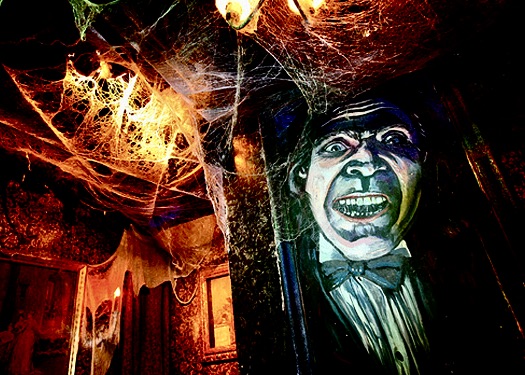
   The man spirit looked like a butler from an old movie. He was wearing a black suit with a white dress shirt, black bow tie, and a waistcoat. He had a long face and a nose that was as sharp as a hatchet. 

   “I don’t have a deed,” he said.

   “Then it’s not really your castle, is it?”

   “Well, no, but I live here.”

   “We heard the castle is haunted.”

   “You heard correctly, young man. There are ghosts and phantoms in every room.”

    “Are they mean?”

   “Not all of them, but you would be playing with fire if you thought otherwise.”

   “Can you show us around?”

   “No, I can’t. I have to return to my quarters.”

   “Are they upstairs? Maybe we could follow you.”

   “No, my quarters are in the carriage house in the back.” He pointed through a window. “There is an underground tunnel that runs from the basement, under the rose garden, and to my quarters.”

   Oliver and Emma looked through the window. There wasn’t a rose garden or a carriage house in the backyard. When they turned back to the butler, he wasn’t there anymore. There was a pile of sand where he had been standing.

   “Where did he go?”

   “Maybe he went down to the basement.”

   “Let’s go look.”

   The basement was dark and musty. It had a smell they didn’t recognize. They didn’t know liquor had been made in the basement during Prohibition. A whiskey still was still in a hidden room of the basement, behind a sealed panel in the wall. They saw a trapdoor in the floor.

   “Maybe he went down there,” Emma said.

   When they pulled the trapdoor open, it went nowhere. There wasn’t a tunnel, or anything, just loose-packed dirt. It was a dead-end. Worms were slithering in the dirt.

   “Oh, gross,” Emma said. 

   “I like glow worms the best,” Oliver said.

   “I like gummy worms the best,” Emma said.

   They went back upstairs. There was a large oil painting in the living room above the fireplace. The painting was of Hannes Tiedemann, his wife Louise, and their children, Dora and August. Every time Oliver looked at it out of the corner of his eye he thought they were moving their heads and looking at him. He stopped looking out of the corner of his eye. They stopped looking at him.

   There were built-in bookcases on both sides of the fireplace. The shelves were packed with books.  All the books were moldy except for one. The book looked new. It’s title was “The World Without Us.”

   “Let’s go upstairs,” Oliver said.

   The stairs were wide and the handrails were dark brown wood. They felt damp and sticky. There was a small round table on the landing halfway up. There was a recently lit cigar in an ash tray on the table. Smoke like a garden snake curled up to the ceiling.

   “That smells terrible,” Emma said.

   “It smells like old armpits,” Oliver said, stubbing the cigar out.

   When they got to the top of the stairs a wall of fog materialized in front of them. It was a green and yellow fog. Emma took a step into it. She began to lose her way. Oliver pulled her back.

   “I thought I was going to pass out,” she said, rubbing her eyes.

   There were four bedrooms on the second floor. There was a collection of small colored glass bottles full of liquids on a side table in the first of the bedrooms. The bottles were labeled. One said, “This Will Make You Larger.” Another one said, “This Will Make You Smaller.” 

   “It’s like Alice in Wonderland,” Oliver said.

   Only one bottle was made of clear glass. It said, “This Will Make You Disappear.”

   “I could use that on some bullies I know,” Emma said. She reached for the bottle. Just as she was about to put it in her pocket it disappeared. A voice whispered in her ear. “That’s not for you.”

   In another bedroom the outside shutters were loose. They banged against the window frame when the wind blew. When Oliver opened the window and reached for the shutters to secure them, they shut and locked themselves. As soon as he walked away they unlocked themselves and started flapping in the wind again.

   “Things have got a mind of their own in this house,” he said.

   The next bedroom had spiderwebs in every corner. There was fossilized cordwood laid in the fireplace grate. There was a bed and there was a sofa, too, big enough to sleep in. Rotting curtains rustled even though the windows were closed and the air in the room was fetid. There was a diary on the bedside table.

   “Let’s take a look at this book,” Emma said. “Maybe it will tell us something about this house.”

   When they opened the book, however, as they flipped the pages they crumbled into yellow fragments. A shred of a page whispered, “Whoever reads my journal, beware of the creature below.” The yellow fragments sprinkled themselves all over the floor. When Oliver and Emma turned to leave, the fragments gathered themselves and  transformed into an arm that reached for their legs. The fingers were long as carrots. They ran out of the room.

   When they opened the door of the last bedroom it was inky black inside, even though the curtains were pulled back and they could see through the window that it was sunny and bright outside.

   “Let’s not go in this room,” Emma said.

   “This house is creepy but it isn’t really any more creepy than that abandoned amusement park in Chippewa Lake dad stopped at last year,” Oliver said. “The one where he said they filmed the movie ‘Closed for the Season.’ The Ferris wheel, remember how it was all rusty, and the Fun House, some of the old walls were still there, painted in Day-Glo green, it was kind of sad.”

   “It was closed forever,” Emma said.

   “That’s a long time,” Oliver said.

   They took the stairs to the top floor ballroom. It was put in by Hannes Tiedemann to cheer up his wife, Louise, after the tragedies the family suffered. He thought she might dance her sorrows away. The ballroom was large, stretching the length of the house. When it was added to the house so were turrets and gargoyles. It was what made the house look like a castle.

   The ballroom was empty. They walked the length of it, their footsteps echoing behind them. The echo was behind time, always a few seconds behind their footsteps. When they turned around to go back the way they had come the echo was gone. There was a specter blocking their way. It was a skeleton wearing a black hooded cloak and carrying a scythe. It was the Grim Reaper.

   “Well, well,” the Grim Reaper said. “What have we got here, Hansel and Gretel?”

Previous: Breaking Into Franklin Castle

Next: Busting Out of Franklin Castle

Ed Staskus posts monthly on 147 Stanley Street at http://www.147stanleystreet.com, Made in Cleveland http://www.clevelandohiodaybook.com, Down East http://www.redroadpei.com, and Lithuanian Journal http://www.lithuanianjournal.com. To get the site’s monthly feature in your in-box click on “Follow.”

“Ebb Tide” by Ed Staskus

“A thriller in the Maritimes, out of the past, a double cross, and a fight to the finish.” Sam Winchell, Beyond Books

Available at Amazon: https://www.amazon.com/dp/B0CV9MRG55

Summer, 1989. A small town on Prince Edward Island. Mob money on the move gone missing. Muscle from Montreal. A constable working the back roads stands in the way.

A Crying of Lot 49 Publication

Breaking Into Franklin Castle

By Ed Staskus

   The first thing Oliver and Emma’s father did when he pulled into the St. Ignatius High School parking lot on the near west side of Cleveland was park the car, get out, and take his children on a tour of the campus.

   “It’s a lot different than when I was here,” he told them.

   “When was that, dad?”

   “The middle 1980s,” he said.

   “That was another century,” Oliver said.

   “That’s right.”

   “That was another millennium,” Emma said. She was two years older than Oliver and knew more big words.

   “That’s right, too, although both of you are making me feel old.”

   “How is it different?” Oliver asked.

   “It’s bigger,” their father said, looking around.

   When St. Ignatius opened in 1886 as a school for Cleveland’s Catholic young men it was both a high school and a college. The college later became Jonn Carroll College and moved to the east side. St Ignatius stayed where it was in its Gothic edifice on W. 30th  St. and Carrol Ave. The grounds got bigger over the years, expanding to fifteen acres. The Saint Mary of the Assumption Chapel was built in 1998 and the O’Donnell Athletic Complex was unveiled in 2001. The Welsh Academy, a middle school for urban boys, was established in the former Foursquare Church building in 2019. By then the campus had grown to nineteen buildings and three athletic fields on twenty three acres. 

   “Are you giving a speech today?” Emma asked.

   “They asked me to speak at Career Day, but it’s not a speech, exactly, more like a panel discussion with other graduates followed up by questions from the students.”

   Their father was an electrical engineer and brought home the bacon so the home fires stayed lit. 

   “Dad, would it be alright if we went to see the Franklin Castle while you give your speech?” Emma asked.

   Oliver and Emma were the Monster Hunters of Lake County. No matter how scary, they couldn’t resist anyplace full of spooks and monsters, especially one that was old and creepy and that happened to be nearby.

   “It’s not far away, so it should be all right. Be careful crossing streets and be back here in two-and-a-half hours.”

   They were a block away when they found a Lime e-scooter with time still ticking on its clock. They had a short argument about who was going to pilot the e-scooter, an argument Emma won by hopping on it and grasping the handlebars. Oliver wrapped his arms around her waist from behind and they sped off in the bike lane. They went down Fulton Rd., turned on Woodbine Ave., went round at a traffic circle getting onto W. 38th St., and before they knew it they were at the Franklin Castle, which was on the north side of Franklin Blvd. They had gone about a mile.

   “You’re not going to tell mom and dad we rode this scooter, are you?” Emma asked her brother.

   “No way!” Oliver said.

   They loved their parents more than anything, but didn’t love everything they said and did. They weren’t in love with crime and punishment, for sure. They thought it was unfair that they couldn’t discipline their parents, who made mistakes just like them, because of the size difference between them.

   “It’s like Godzilla always says,” their friend Tommy One Shoe said. “Might makes right.”

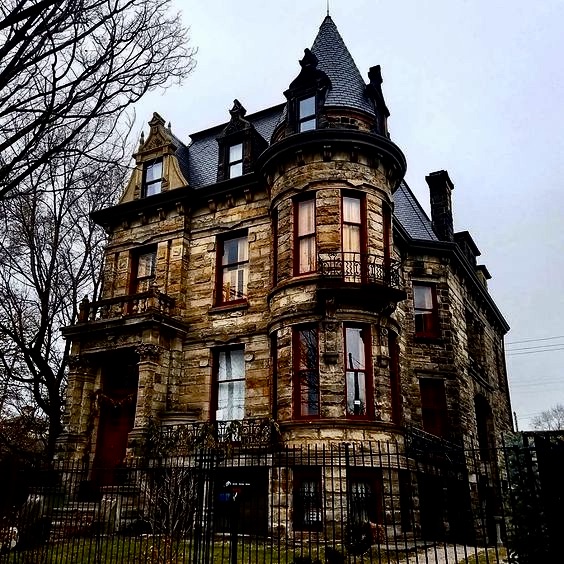
   Franklin Castle was a big stone house built in the early 1880s. It was built where a two-story wood house called Bachelor’s Hall had once stood before being torn down. Bachelor’s Hall was built by the Wolverton brothers. They fought in the Civil War with the Ohio Light Artillery. Only two of the four brothers survived the war. Only one came back to Cleveland. After he died and after Franklin Castle was built visitors reported seeing ghostly soldiers in faded uniforms in the backyard galloping on desperate horses.

   The stone house was built by Hannes Tiedemann, a successful merchant and banker, for his family. His family was his mother, his wife Louise, and six children. His15-year-old daughter Emma died of diabetes. Then his mother Wiebeka died. In the space of no time he buried three more children who died of infectious diseases, two of them of measles. The last children, Dora and August, survived.

   The diminished family lived in their new home on Franklin Blvd. until Louise died in 1895. Soon after the new century dawned Dora and August died. Their father retired to Steinberg, his sprawling summer house on Lake Erie in nearby Lakewood. He passed away in 1908, alone and worn out by tragedy. Franklin Castle became the home of the German Socialist Party. When nobody liked socialists anymore it became the German American League for Culture. Their singing club was very popular, as was the beer garden. Singing in the garden while waving a stein was always a good time. Everybody called it Eintracht Hall in those days. 

   After the Germans moved out in 1968 the Romano family moved in. The lady of the house was warned that “this domicile is evil and you shouldn’t have come. You should move out.”  One winter day she sent her children to the top floor to play. When they came down they told their parents about finding a sad little girl in a ragged dress who asked for a cookie to cheer her up.

   They searched the top floor but no child was found. When it happened again they locked the door and kept it locked. They started hearing organ music on weekends, even though there was no organ in the house. Their children woke up in the middle of the night to find their blankets being yanked off them by unseen hands. The family moved out in 1974 and the house was taken over by a man who began offering public tours of “Haunted Franklin Castle.” 

   “What’s so haunted about it?” Emma asked.

   “Lights go on and off by themselves, mirrors suddenly fog up, voices can be heard in empty rooms, and doors fly off their hinge, for starters,” Oliver said.

   “Let’s go inside and see,” Emma said.

   “Does anybody live there?”

   “When I asked dad, he said nobody lives there anymore.”

   When they tried to get inside the house they discovered all the doors were locked. They knocked on the front door. They looked through windows. They knocked on the back door. Nobody answered.

   They were scratching their heads outside the back door when Emma plucked two bobby pins out of her hair. The first pin was going to be a replacement for a key. She bent the rounded end until it was perpendicular to the two free ends. She stuck the rounded end into the key slot. It would act as a handle. She unbent and flattened the second pin, making a long straight pick. She bent one end slightly and slid the bent end into the top half of the keyhole, above the pin she had already inserted into the lock. Emma used her bobby pin to push the pins up, one at a time, until the cylinder was free to turn. She turned it with the first pin she had made into a handle. It was easy as pie. The door opened and they went inside.

   “How did you learn to do that?” Oliver asked.

   “It’s a secret.”

   “No, tell me.”

   “I’ll tell you when you’re 12-years-old like me.”

   The back door suddenly slammed shut. The air got hot and gluey. It  got dark as a tar pit. They heard heavy footsteps.

   “Who has broken into my castle?” the voice of bad juju behind them said.

Next: Franklin Castle Walkabout

Ed Staskus posts monthly on 147 Stanley Street at http://www.147stanleystreet.com, Made in Cleveland http://www.clevelandohiodaybook.com, Down East http://www.redroadpei.com, and Lithuanian Journal http://www.lithuanianjournal.com. To get the site’s monthly feature in your in-box click on “Follow.”

“Ebb Tide” by Ed Staskus

“A thriller in the Maritimes, out of the past, a double cross, and a fight to the finish.” Sam Winchell, Beyond Books

Available at Amazon: https://www.amazon.com/dp/B0CV9MRG55

Summer, 1989. A small town on Prince Edward Island. Mob money on the move gone missing. Muscle from Montreal. A constable working the back roads stands in the way.

A Crying of Lot 49 Publication

Silent Cal Sounds Off

By Ed Staskus

   Emma met Calvin the day after she got back from a week at a piano camp in Oberlin. Her brother Oliver was still in Lithuania with their father, who had gone there on a working trip. Their father was an electrical engineer.  Oliver was on his summer vacation with him, scaring up shadows in the Baltics. He was the Monster Hunter of Lake County.

   His sister was still disgruntled about the piano camp. She didn’t even exactly like the piano anymore. The clarinet was her thing. She was getting good enough on it to make it sing and shout. She played it in the school band.

   Emma was eating two hard-boiled eggs and licking teaspoons of hummus  at a round table on the outside patio when their neighbor’s dog started barking. It was a Toto terrier kind of dog. The neighbor was an old Italian lady who always dressed in black. She tied Toto to a stake  two or three times a day outside her sliding back door for twenty or thirty minutes. While he was outside he barked at anything that moved, including insects. He once barked a coyote out of the neighborhood. Her father resented the dog and the neighbor. He worked out of the house two days a week and said the dog drove him nuts.

   “I don’t want to talk about it,” he told his wife. He wouldn’t talk to the old Italian lady and had long ago given up trying to reason with the dog.

   Emma put her second egg down when she saw a boy come out the back of the house and flop down on the grass next to the dog, who was barking at a bluejay. The bird was barking back at him. Neither understood what the other one was saying.

   “Hi,” Emma said. 

   “Hi,” the boy said.

    “Are you our new neighbor?”

   “Yeah.”

   “Are you the boy who started school with us just before summer started?”

   “Yeah.” 

   “And are you the one who everybody calls Silent Cal?”

   “Yeah.”

   Calvin had moved in with his grandmother at the end of April. By mid-summer hardly anybody in the neighborhood had even spoken him. It was partly the dog’s fault and partly his own fault. The dog was too loud. HCalvinwas too quiet. The neighbors were disgruntled by the noisy dog. They didn’t notice Calvin, who was quiet as a mouse. 

   One day at lunch just before school let out for the summer, a girl sitting across from Calvin in the lunchroom said, “Everybody says you never say more than two words. I bet I can make you say more than two words.”

   “Bet what?”

   “I bet my chocolate chip cookie.”

   “You lose,” Silent Cal said reaching for the cookie.

   “How come you don’t talk much?” Emma asked.

   “Because my dad said so.”

   “He told  you not to talk?”

   “Yeah.”

   “How come?”

   “It was after my mom died,” Calvin said. 

   “Your mom died?”

   “Yeah.”

   “That’s terrible. How did it happen?”

   “She was driving me to school when we lived in Brecksville. A car in front of us rode over some kind of pipe and it went flying. It hit our windshield and killed my mother.”

   Emma didn’t know what to say. She couldn’t imagine it happening to her mother. The only dead people she had ever seen were grandparents. They were never killed by pipes. Grandparents wore out and one morning didn’t wake up.

   “My dad went back into the army and they shipped him away to where Arabs are fighting. When I asked him when he was coming back he told me to shut up. He said he didn’t want to hear a word from me ever again. Then he dropped me off here at my grandmother’s house.”

   “Is he coming back?”

   “I don’t think so. I think he hates me.”

   “How could that be?”

   “Whenever I tried to talk to him, even before mom died, he was always telling me what to do, even if I wasn’t talking about a problem, or he would start yelling at me for the bad choices he thought I was making. He was always talking down to me. I tried to tell him I wasn’t a kid anymore but he wouldn’t listen. When I asked him to listen, he looked like he wanted to hit me.”

   Emma’s parents could be bossy and strict, but she knew they would never do that. They never had. She knew they never would.

   “Did your mom listen?”

   “She always listened. We had great talks. I miss her so much.”

   “You can still talk to her if you want. She’s not here but she’s still here. My  brother Oliver is always talking to ghosts and spirits. They talk back whenever they have something to say, although you can’t always understand what they’re saying since they don’t always speak English.”

   “Oh,” Calvin said.

   “My brother didn’t talk for a long time after he was born. When he wanted something he would point to it and make funny sounds. Finally, our mom pretended to not hear him when he was doing that. She ignored him until he started talking. Gosh, now we can’t shut him up!”

   Calvin looked thoughtful.

   “Are you going to live here from now on?” Emma asked.

    “Yeah, I think so.”

   “Well, if your dad isn’t here to tell you shut up, maybe you could start talking. That’s how to make friends. When you don’t talk it makes the other person feel bad. They feel like you don’t like them. They don’t know what you’re thinking, what’s going on. It makes it seem like you don’t care. How can I be your friend if you won’t talk to me, know what I mean”

   “I think so, but what is there to talk about?”

   “What flavor popsicle do you like?” 

   “Grape.”

   “I like orange. What games do you like?”

   “I like kickball.”

   “ I like checkers. I always beat my uncle. He said he’s going to bring a chess board the next time he visits, but I told him I don’t know how to play chess.”

   “What did he say?” 

   “He said, all the better, whatever that means.”

   “I played checkers with my mom. She was better than me, but I won sometimes.”

   “How old are you?” Emma asked.

   “I’m 12.”

   “Oh, that’s the same as me. When were you born?”

   “In September.”

   “What day?” 

   “September 1st.”

   Emma was flabbergasted. She was born on September 1st the same as Calvin.

   “You’re a blue moon baby, just like me.”

   “That’s what my mom always said. She said I was a blue moon baby because there were two full moons that month on the first day and the last day of the month I was born.”

    “What’s your dog’s name?”

   “I call him Ziggy.”

   “Do you want to take him for a walk. There’s a trail through the woods back there. We could take his leash off. He could run around. Maybe he wouldn’t bark so much if he could run around once in a while.”

   “Maybe he’s trying to tell us something,” Calvin said.

   “I know, but his barking makes my dad say bad words. Let’s go and get it out of his system.”

Ed Staskus posts monthly on 147 Stanley Street at http://www.147stanleystreet.com, Made in Cleveland http://www.clevelandohiodaybook.com, Down East http://www.redroadpei.com, and Lithuanian Journal http://www.lithuanianjournal.com. To get the site’s monthly feature in your in-box click on “Follow.”

“Ebb Tide” by Ed Staskus

“A thriller in the Maritimes, out of the past, a double cross, and a fight to the finish.” Sam Winchell, Beyond Books

Available at Amazon: https://www.amazon.com/dp/B0CV9MRG55

Summer, 1989. A small town on Prince Edward Island. Mob money on the move gone missing. Two hired guns from Montreal. A constable working the back roads stands in the way.

A Crying of Lot 49 Publication

Bird in the Hand

By Ed Staskus

   Oliver was watching a black-billed magpie eat worms, beetles, and caterpillars. It was a three course dinner. He had seen magpies forage for berries and grains in the fall before they went away somewhere. He didn’t know where they went during the winter, but he knew they always came back to the wild garden his father had planted in the backyard.

   It was the last week of March. The month used to be a cold month in northern Ohio, but lately it had turned into a warm month. Everything was budding and going green sooner than ever. The magpie’s better half was building a nest in a tree next to the garden. The nest was cup-shaped and lined with grass and mud. Sticks were sticking out all over it. There were two entrances to it.

   “Just in case,” the lady of the nest said, enlarging one of the entrances. She wasn’t a licensed carpenter, but she knew what she was doing. She was going to be laying six or seven eggs soon enough. When that happened, she would keep the clutch warm. Once the eggs hatched and came to life she would be more than busy keeping them in line and fed. In the meantime, she would take care of her incubating chores.

   Magpies are one of the world’s most intelligent birds. Like people, and unlike almost everything else, they can recognize themselves in mirrors. They make and use tools and work in teams. They play games and can imitate speech. They are particularly well known for their squawking and singing, especially ‘Three Little Birds’ by Bob Marley and the Wailers.

   The man of the nest, who was snacking on mayflies, looked at Oliver. “Is that maniac still living down the street?” the bird asked him.

   “Yes,” Oliver said. “Dad said he probably will never move away.”

   “We appreciate your father talking to him.”

   “He’s a man of few words. I think he just told him to stay out of our yard.”

   Their neighbor was a man by the name of Gilbert. Oliver and Emma, his sister and right-hand man, called him Sour Head. He was always complaining about something. He was married but hardly anybody ever saw his wife, except when she was mowing the lawn or washing the car. She did the grocery shopping and Home Depot shopping, too. They had children but nobody ever saw them. They lived in another state. Gilbert had been a businessman but was now retired. He watched FOX News day and night. “In this corner, still undefeated, is Gilbert with his long-held beliefs.” He had nutty opinions up the wazoo. He didn’t like magpies, among other things.

   Magpies are black and white birds with long diamond-shaped tails. Their coloring has a glossy sheen to it. They are loud mouths. Somebody who talks obnoxiously is sometimes called a magpie. Gilbert had a chatterbox neighbor he called a magpie. “Idle chatter is for the birds” is what he said, never mind his own idle chatter. What got his goat more than anything was their thieving. 

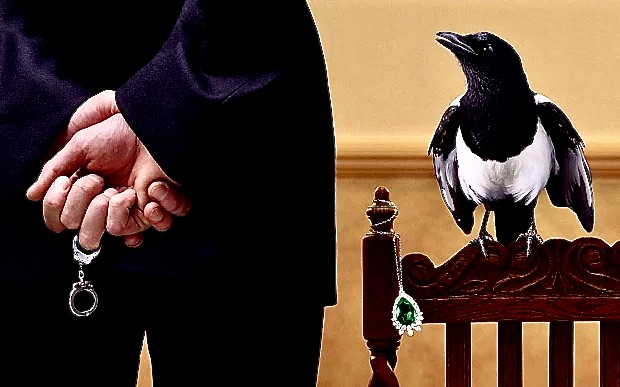
    “They’re kleptomaniacs” is what he said. “There was that woman in Chardon who lost her engagement ring three or four years ago. A bird watcher found it in a magpie’s nest. Then there was the man in Fairport Harbor who was gardening, took off his watch so it wouldn’t get dirty, and then watched a magpie fly away with it. My wife keeps some colored crystals on the window ledge and they are always pecking on the glass trying to get them.”

   “That doesn’t mean they are kleptomaniacs,” Oliver said.

   “Then why is there some opera some Eyetalian wrote called the ‘The Thieving Magpie’ if they aren’t kleptomaniacs?” He believed seeing a magpie brought bad luck. “One for sorrow, two for joy, three for a funeral, four for birth, five for heaven, six for hell, seven for the devil, his own self,” is what he said, even though he didn’t know exactly what it meant.

   “Italians are always writing operas about one thing or another,” Emma said. She played the piano and was in the school band. She played the clarinet in the marching band. She knew more about music than anybody in their neighborhood.

   “You think you’re so smart,” Gilbert said. He didn’t like Emma because he knew full well she thought she was smarter than him, even though she was only twelve years old. He wasn’t far off the mark, the mark being she was smarter than him. The only thing Gilbert knew anything about was making money, by hook or by crook. He was a miser by another name. He suspected Emma didn’t care all that much about money. He didn’t like that. He resented it.

   “If you’re so smart, how come you don’t know the magpie is the only bird who didn’t mourn for Jesus when he was crucified? Not only that, it was the only bird who didn’t go into the ark with Noah. Instead, it sat on top of the ark and cursed up a storm while the world was being drowned.”

   Oliver and Emma looked at each other. Emma threw up her hands. “You are kind of weird, mister,” she said, brushing aside his scowl. 

   It wasn’t long before Gilbert got what he thought was a great idea. He knew the magpies were laying eggs and before long there would be a flock of them. Even though he had been warned to stay out of Oliver and Emma’s backyard, he decided he would sneak into it, steal the eggs, and throw them into the garbage for the racoons. That would show the magpies who was boss.

   The next night, after everybody had gone to bed, he carried his ladder to their house, made sure no lights were on anywhere, and propped the ladder against the tree. He saw the nest. He pulled on a pair of antibacterial gloves. He knew their nest was full of germs, or worse. They weren’t even real Americans. They had snuck into the United States from Asia or some other foreign place. He started up the rungs. When he got to the nest he pulled a disposable bag out of his back pocket. He reached for the eggs but was surprised to see that they had hatched.

   No matter, he thought, I’ll just stuff them birdies into my bag and drown them in the Grand River.

   No sooner did he come up with his new plan of action than the lady of the nest began putting up a racket. She struck at him with her long beak. Gilbert tried to brush her aside. He didn’t see the man of the nest swooping down on him. The magpie wasn’t about to let Gilbert threaten his nestlings. He had survived many hardships, struggled to lay hands on some real estate, and been able to find a partner. He wasn’t about to lose it all to a bloodthirsty peddler.

   The magpie swooped and jabbed at Gilbert. He wouldn’t give up. Gilbert waved his bag at him. He swooped again. After Gilbert was pecked several times, he gave up. He had always been all about easy money. He started down the ladder. He was fuming and sputtering curses.

   One of the chicks leaned out from the nest. He was blind and pink. He was pink as a Barbie doll. His eyes would open and downy feathers appear in about a week. He farted and pooped. The poop went over the side and splatted on top of Gilbert’s bald pate. When he reached to wipe it off, the magpie swooped at him one more time. Gilbert waved him away with his other hand, the hand that had been holding on to the ladder. When he did, no hands were left holding on to the ladder. He fell off and landed on his butt, yelping when he bounced. Lights started going on in nearby houses. The Perry Police arrived and cited him for trespassing.

   The next morning Oliver and Emma found the ladder still propped against their tree. Oliver went up it to check on the birds. He gave Emma the high sign. “Hey, let’s go find some wood and build a bird feeder,” he said. “They look hungry. And let’s get rid of this ladder in case Sour Head comes back.”

Ed Staskus posts monthly on 147 Stanley Street at http://www.147stanleystreet.com, Made in Cleveland http://www.clevelandohiodaybook.com, Down East http://www.redroadpei.com, and Lithuanian Journal http://www.lithuanianjournal.com. To get the site’s monthly feature in your in-box click on “Follow.”

“Made in Cleveland” by Ed Staskus

Available on Amazon:

A Crying of Lot 49 Production