By Ed Staskus
“No one’s ever asked me to do anything like this before, dad,” Oliver said. “I mean, help the other side.”
“I didn’t think so, but my friend Patrick knew you were good at running down ghosts and monsters and once asked me if I would get you to help out if the theater ever needed help that way, and I said yes.”
“I guess I could. Who is your friend?”
“He’s more of a former friend.”
“Did you have a fight?”
“No, nothing like that. He died a few years ago.”
“Oh.”
Patrick Colvin had been born in New Jersey but grew up in northeastern Ohio. He graduated from Lakewood High School in 1983 and Cleveland State University in 1989. In his time he worked at Severance Hall, Blossom Music Center, and the Rock and Roll Hall of Fame. When he ran the Westown Community Development Corporation he was instrumental in saving the Variety Theater from demolition.
“Why did he want to save it?”
“He said it was historic.”
“Like in ancient history?”
The Variety Theater opened in 1927. It was built at a cost of one million dollars, or twenty million dollars today. The first movie shown there was “Hula.” It was about a young woman who lives on a plantation in Hawaii and wears pants and rides horses. Everybody calls her a wild child. She doesn’t care about money. She likes to hula dance. Her boyfriend likes to watch her hula dance.
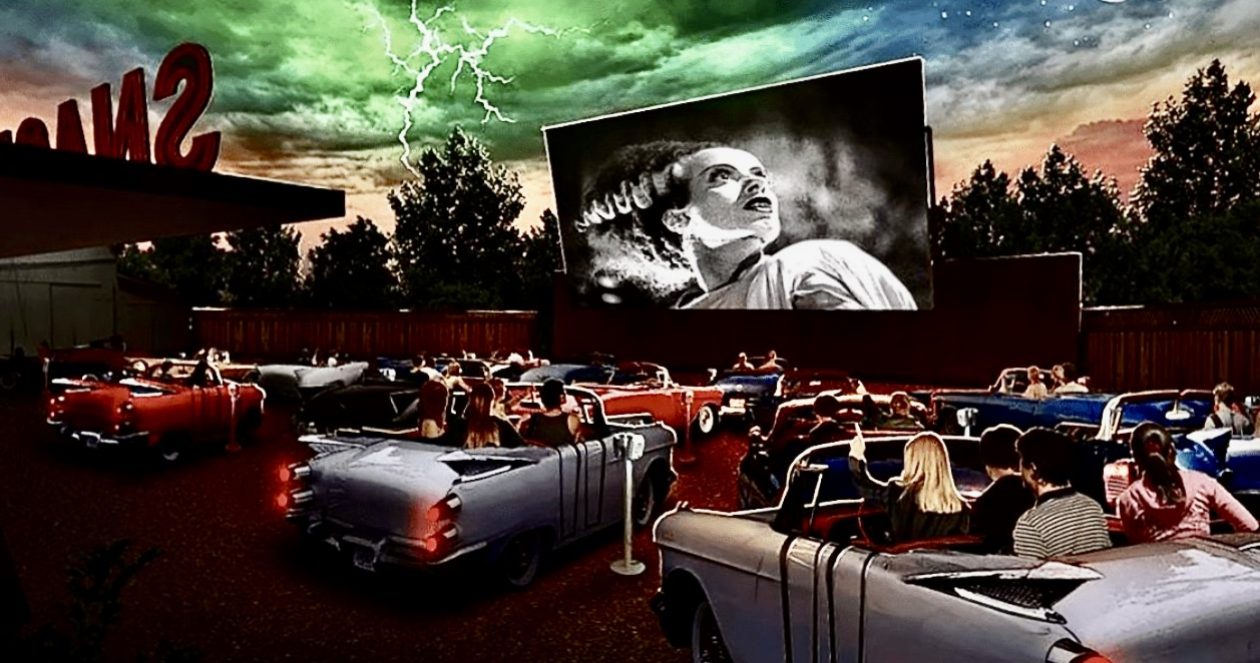
The theater sat nearly two thousand people. It had an orchestra pit, cut-glass chandeliers, and a Kimball organ. The organ was huge. Warner Bros. bought the theater in 1929 and showed their brand name romance and gangster movies there until 1954, when the Supreme Court said Warner Bros. was a monopoly. After that it became a neighborhood movie house. They screened crowd pleasers like “House of Dracula” and “I Shot Jesse James.” It became a punk and heavy metal music venue when hardly anybody wanted to go see movies there anymore.
“They did music shows until the Motorhead show in 1984, which I was at, sort of. It became a wrestling gym a couple of years after that but closed for good around 1990.”
“What is Motorhead?”
“They were a band from England back then, the loudest heavy metal band in the world. They set the world’s record for being the loudest while at the Variety Theater.”
“Did they blow your ears out?”
“No, because I didn’t have a ticket to get in.”
“How could you be at their show if you didn’t have a ticket?”
“I didn’t have enough money to buy a ticket, but a schoolmate and I went anyway. We took a bus there. The driver almost didn’t let us on because we had folding lawn chairs with us. But, we had brought a family size bag of Charles Chips and gave him some. He liked kettle chips so he let us on. We had to sit in the front so he could reach around and get some chips whenever he wanted.”
“You brought your own chairs?”
“We sat in the outside portico behind the ticket booth. We heard the band loud and clear. I think the whole neighborhood heard the band loud and clear, at least until near the end when the power was cut off.”
“What happened?’
“The band was so loud that the ceiling plaster began to crack and fall on everybody. When it kept cracking and falling a janitor pulled the plug. I heard the band was mad about it, although there wasn’t much they could do. They played a few more songs acoustically but then stopped. They didn’t come back for an encore.”
Just then they turned the corner onto Lorain Ave. and the theater was in front of them. They had driven from Perry, where they lived almost an hour away. Oliver jumped out of the Jeep Cherokee. His father got out and stretched. “I’ve got to get my sea legs back.” His father was always saying something like that. Sometimes he said “I’ve got to unfold myself.” Other times he said “I need to find my grease gun.”
“Who is it we’re looking for?”
“Top Hat Man.”
“Why?”
“Somebody stole his headgear.”
“Do you know where we can find him?”
“They said he usually roams around but has lately been sitting in a corner crying his eyes out.”
“I know of many spirits who roam the theater,” Patrick Colvin once told Oliver’s father. “They move things around, barricade doors, and generally make themselves known. There’s the ‘Lady in White’ who used to perform in the theater when they did vaudeville shows. I usually see her by the water fountain. I’m pretty sure her name is Claire. There’s the ‘Man in the Balcony.’ He sits up there watching the empty stage with reddish eyes. There’s the ‘Stage Rigger.’ He was a stagehand who fell to his death from the rigging. There’s the ‘Laughing Child.’ I have found a stuffed animal in different rooms. Whenever I reach for it I hear children laughing. There’s ‘Nancy Whiskey’ who is always leaving empty bottles around, which is a nuisance. Sometimes people say I should hire an exorcist, but it’s their home and they are here to stay.”
It took some time to find Top Hat Man. He wasn’t in the lobby or the auditorium or the orchestra pit. He wasn’t in the wings of the stage or up in the fly loft. He wasn’t in any of the bathrooms. They checked them even though they didn’t think he answered the call of nature anymore. They found him in one of the dressing rooms.
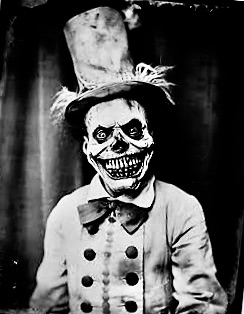
He was sitting on a stool in a corner. He was wearing a knee length frock coat and a jumbo bow tie. His eye sockets were black and his teeth were very bad. There was an old vanity mirror on the wall opposite him. The frame was chipped and there was mirror rot in the glass. Even though Top Hat Man was facing it there was no reflection of him.
“He must be the real deal,” Oliver said to himself.
“Watch yourself,” his father said. “He looks disturbed.”
“What’s the matter?” Oliver asked Top Hat Man.
“Somebody stole my hat.”
“Did it mean a lot to you?”
“It meant the world to me.” Top hats were hats, but they were also symbols of authority and sophistication.
“How can I be Top Hat Man if I don’t have one?”
The hats got their start in England in the late 18th century. It was the headwear of the rich and famous. It was made of beaver fur at first and later on of silk plush. In the mid-19th century it got stretched out and became a stovepipe hat. Abraham Lincoln wore one. He kept his speeches stashed inside the tall crown when he was on the way somewhere to make a speech.
“How do you come to be here?”
“I was an actor here long ago when it was vaudeville.”
“Do you suspect anybody?”
“It had to be an inside job so I suspect everybody who haunts this place.”
“Have you looked for it?”
“Everywhere, day and night. I think I have as much chance of finding it now as a rabbit at a dog show.”
“Was it a collapsible kind of top hat?”
“Yes.”
Back in the day collapsible top hats were worn by gentlemen when they went to theaters. Since it could be squashed flat they could store it under their seats during the show.
“Where did you see it last?”
“In this dressing room on my bed where I put it when I took a nap.”
“Wait here, we’ll be back soon.”
Top Hat Man slumped forward on his stool and sighed.
“Do you have an idea?”
“Do you remember last year, dad, when Tommy One Shoe came over for our Halloween party? He was wearing a fake curly moustache, tails and a cape, and a top hat. It was the collapsible kind. We ended up playing frisbee with it until a crow caught it in mid-air and flew away.”
“I remember there was a lot of noise during the party.”
“Anyway, I don’t think it was an inside job, even though it was an inside job. The ‘Lady in White’ and ‘Nancy Whiskey’ wouldn’t be interested. The ‘Stage Rigger’ wouldn’t care about any such thing as a top hat. The ‘Man in the Balcony’ never leaves the balcony. The ‘Laughing Child’ has stuffed animals and doesn’t need any old hat.”
“So who was it?”
“All actors believe leaving a hat on a bed is bad luck. I think Top Hat Man himself stole the hat when he woke up from his nap and hid it somewhere so bad luck wouldn’t happen.”
“Where could he have hidden it?”
“I think he collapsed it and hid it in his quick change bag. In the meantime, he didn’t want to think about an evil spirit bringing him bad luck and forgot all about doing it, and where he left the kit bag.”
“It’s a big theater.”
“Let’s find the Green Room.”
Green Rooms were backstage lounges where actors sat around between scenes, waiting for their cues. They were called that because the walls were painted green. Oliver and his father found the Green Room soon enough. It was filled with decrepit sofas and armchairs, prop crates, and costume racks. There was fake shrubbery. There was a Tiring Trunk. Oliver went straight for it. He opened it and tapped the bottom. There was an echo.
“It’s got a false bottom.”
They pried open the false bottom and found the quick change bag with the collapsed hat in it. They went back to Top Hat Man’s dressing room. When Oliver walked in he held the brim of the hat on both sides with his hands, wiggled it with his fingers, and the spring mechanism clicked. The hat snapped open.
“Voila,” Oliver said, handing it to Top Hat Man, who promptly put it on.
“Thank you. I feel like myself again.”
As they were leaving the Variety Theater Oliver looked up at the plaster ceiling Motorhead had rattled with their heavy metal music. It was still full of holes and cracks thirty years later.
“They must have been loud as thunder when it comes over the lake.”
“They toured with ten tons of amplifiers.”
“What was that you told me about noise one time?”
“One man’s noise, son, is another man’s music.”
Ed Staskus posts monthly on 147 Stanley Street http://www.147stanleystreet.com, Made in Cleveland http://www.clevelandohiodaybook.com, Down East http://www.redroadpei.com, and Lithuanian Journal http://www.lithuanianjournal.com. To get the site’s monthly feature in your in-box click on “Follow.” His books are available on Amazon and Apple Books.
“Home Movies”
Coming of age in the 1960s and 1970s. A collection of short stories set in Cleveland, Ohio.
A Crying of Lot 49 Production

